
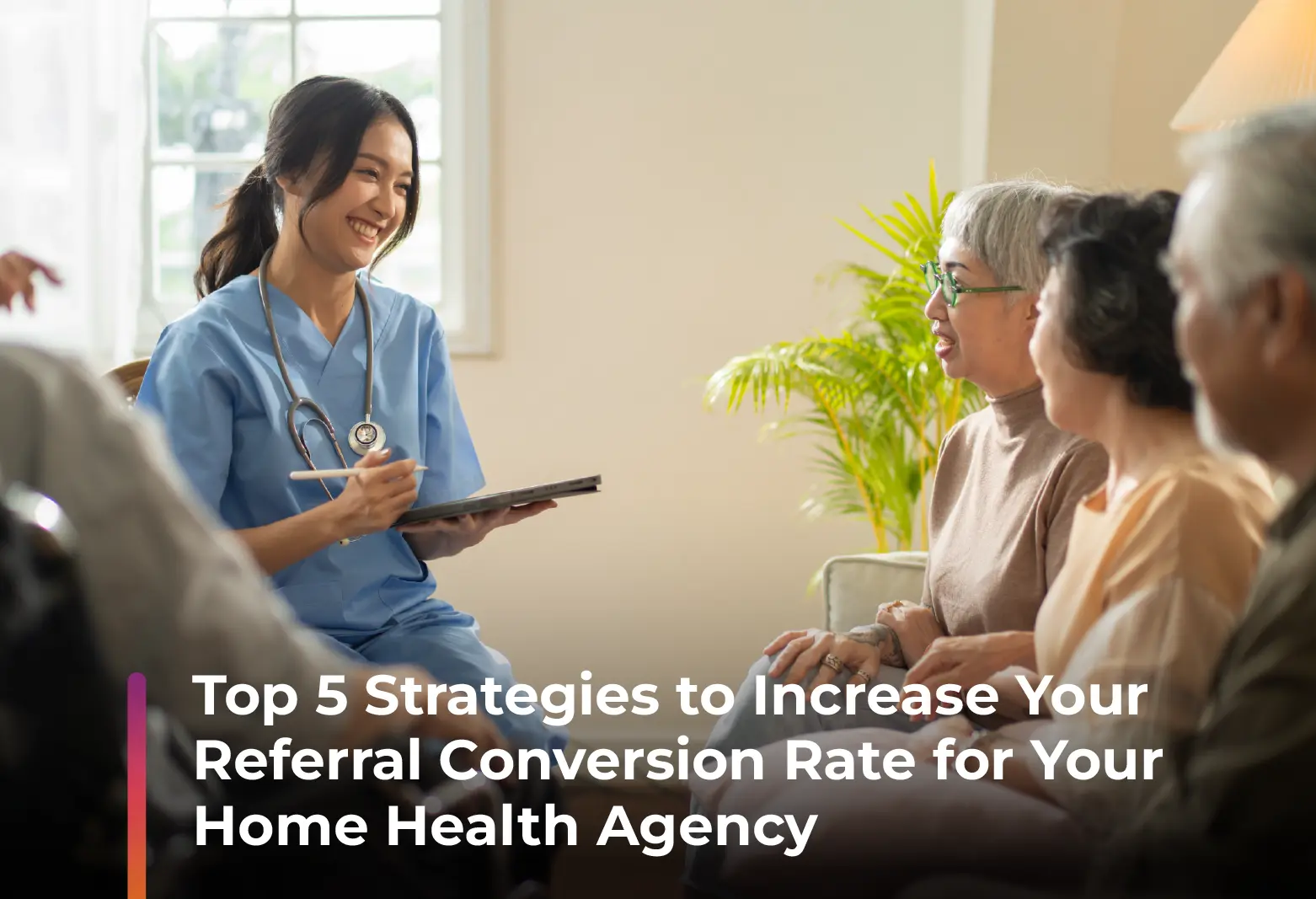
Home health agencies live and die by referrals. They’re faster to convert, cheaper to acquire, and more loyal than any other lead source.
Yet most agencies are quietly losing 30–40% of the referrals they receive — not because the patient chose someone else on purpose, but because the intake process was too slow, too manual, or too disconnected.
In 2026, that gap is no longer acceptable. Now, home health agencies are investing in AI-powered referral intake, real-time analytics, and 24/7 response systems that capture referrals your team misses after hours. If your referral conversion rate is stuck below 70%, this guide is for you.

What is Referral Conversion Rate and What are Good Benchmarks?
Referral Conversion Rate (RCR) is the percentage of referrals that successfully become paying clients for your home health agency.
Home health agency referrals are among the most effective methods for acquiring new customers, as they rely on your established trust and credibility with your existing clients.
These clients recommend your services to their friends, family, or colleagues, creating a powerful endorsement. However, generating referrals is only part of the equation—you must also convert them into paying customers.
Referral Conversion is calculated as:
RCR = (Converted Referrals ÷ Total Referrals Received) × 100
According to the 2025 Activated Insights Benchmarking Report, agencies tracking every inquiry experienced nearly $812,000 more in annual revenue than those that didn’t. Tracking referral conversion isn’t a nice-to-have metric — it is one of the highest-leverage operational decisions you can make.
Industry benchmarks suggest:
- Below 55%: Significant process gaps — likely in intake speed, staff training, or service matching
- 55%–70%: Average performance — room for improvement in follow-up and data-driven prioritization
- 70%–85%: Strong performance — competitive edge through process discipline
- 85%+: Best-in-class — typically powered by AI-assisted intake and 24/7 response systems
According to the 5th Edition of the Private Duty Benchmarking Study by the Home Care Association of America, the top sources of referrals for home health services are as follows:
| Referral Source | Share of Referrals (%) |
|---|---|
| Current & former clients + family | 19.5% |
| Hospital discharge planners | 8.8% |
| Medicare-certified home health agencies | 7.1% |
| Skilled nursing facilities | 5.9% |
| State Medicaid waiver programs | 5.7% |
| Hospices | 5.1% |
| Geriatric care managers | 4.2% |
| Case managers (Area Agencies on Aging) | 4.0% |
| Assisted living facilities | 3.7% |
Key Insight: Past and current clients generate nearly 1 in 5 of your referrals — yet most agencies invest almost zero time in structured client-to-client referral programs. This is the single largest untapped channel in home health today.
Improve conversions by fixing intake inefficiencies →
Referral Intake Automation Guide 👉
Why it matters in home health agencies
And there are several reasons you should care about tracking your referrals. Here are some of them-
- Faster Client Acquisition: Referrals in home healthcare typically convert 2–3x faster than cold leads.
- Higher Trust Factor: Referred clients already trust your agency through a friend, family member, or healthcare partner.
- Better Retention: Referred clients stay longer, boosting loyalty and lifetime value.
- Revenue Growth: Even a small increase in RCR can significantly raise revenue by maximizing existing leads.
- Optimized Operations with AI: Automated referral tracking and communication reduce manual effort by 30–50%.
So, before we develop strategies to improve the referral conversion rate, let’s examine the challenges to boosting it.
Referral Conversion Challenges in Home Health Agencies
Converting referrals into paying clients can be a complex process in the home health industry. Despite being a top source of new clients, referral conversions often encounter specific challenges that hinder their effectiveness. Here are some key challenges, along with relevant statistics:
-
Slow Response Time
Speed is a critical factor in referral conversions. Clients often contact multiple agencies simultaneously; the first agency to respond and provide clear information usually secures the client.
However, with a high volume of referrals from various sources, home health agencies take time to make decisions. It takes 70 minutes for intake coordinators to thoroughly review an average referral packet to reach an informed admit or decline decision.
-
Service-Needs Mismatch
Many referrals fail to convert because the client’s needs don’t align with the agency’s services. A study revealed that 30% of referrals in-home healthcare are rejected due to a mismatch in service offerings, such as unmet specialized care requirements.
-
Weak Referral Partnerships
Hospital discharge planners, SNF case managers, and physicians operate on trust built over time. Agencies that don’t have a structured outreach and relationship-maintenance cadence lose ground to competitors who do. A single physician partnership can yield dozens of referrals annually if nurtured consistently (Brasstacks/Home Care Marketing Pros.
Top 5 Strategies to Increase Referral Conversion Rate
Converting referrals into paying clients is a critical yet challenging aspect of home health operations. To address the complexities involved, agencies must adopt a strategic approach that enhances efficiency, communication, and data-driven decision-making. Here are five proven referral strategies for home health to improve your referral conversion rate significantly:

-
Implement a Rapid Response System with Automated Data Extraction
Speed is paramount in converting referrals. A rapid response system, including AI powered referral management, ensures that every referral is acknowledged and processed swiftly, minimizing delays that can lead to lost opportunities. Leveraging tools that automate data extraction from referral sources (e.g., electronic health records and discharge forms) reduces manual effort and ensures accuracy.
Benefits:
- Faster response times, often within minutes of receiving a referral.
- Streamlined data entry, reducing errors and saving valuable time.
- Enhanced client trust due to prompt and professional communication.
-
Conduct Structured Information Gathering
The first phone call or intake form submission sets the tone for the entire client relationship. Agencies with scripted, empathy-led intake protocols see measurably higher conversion because families feel heard and trust is established immediately.
Every initial interaction should capture:
- Medical conditions and care complexity level (to check service match before investing further)
- Caregiver preferences and prior care experience (to personalize the recommendation)
- Decision-making timeline and financial constraints (to prioritize your follow-up efforts)
- Payer source (Medicare, Medicaid, private pay, long-term care insurance)
-
Prioritize Staff Training and Development
Your staff plays a pivotal role in referral conversion. Training intake coordinators and care managers in effective communication, empathy, and problem-solving equip them to handle inquiries confidently. A well-trained team can address client concerns, explain services clearly, and build rapport that drives conversions.
Benefits:
- Improved first impressions are critical for gaining trust.
- Better handling of objections or questions, leading to fewer drop-offs.
- Increased staff confidence and morale, enhancing overall service quality.
-
Leverage Automated Communication with AI Agents
AI-powered agents in referral can handle initial inquiries, schedule consultations, and follow up with prospective clients, ensuring consistent and timely communication.
These tools can provide instant responses to frequently asked questions, collect essential data, and pass it on to human staff for further action.
Benefits:
- 24/7 availability to engage prospects outside business hours.
- Faster initial contact increases the likelihood of conversions.
- Reduced workload for staff, allowing them to focus on high-priority tasks.
AutomationEdge Insight:
Butte Home Health & Hospice, a renowned agency that created automated communication using AutomationEdge Referral Intake CareFlo AI, reduced the referral response time by 70%, and with 24/7 referral coverage.
Find out more about their success story
AutomationEdge Insight-
Bridge Home Health a renowned home care agency increased their referral conversion rate by 20% with 24/7 bot assistance which allowed to capture after-hour referrals regularly. They also reduced response times to 2 minutes and cut 7 FTEs from the referral intake team.
-
Gain Real-Time Data Insights and Analytics
Data-driven decision-making is essential for improving referral conversion rates. Real-time analytics can track referral sources, response times, conversion patterns, and common reasons for rejection. This visibility allows agencies to refine their strategies, address bottlenecks, and focus on high-performing referral sources.
Benefits:
- Identifies trends and opportunities to improve referral performance.
- Pinpoint weaknesses, such as delays or mismatched services, for targeted improvements.
- Enables proactive adjustments to maximize efficiency and effectiveness.
Request Access to Home Care Experience Center
Experience our solutions with deeper information and demo packs.
2026 Trends Shaping Home Health Referral Conversion
The referral landscape is shifting. Here’s what forward-looking agencies are doing:
- Agentic AI intake systems — AI agents that handle end-to-end intake without human intervention, escalating only edge cases to coordinators
- Telehealth-enabled rapid assessments — virtual intake visits conducted within hours of referral, accelerating the admission decision
- EHR bi-directional integration — referral data flows directly into and out of your EHR/EMR, eliminating duplicate entry and the errors that kill conversions
- Referral source scorecards — shared quarterly with your top hospital and SNF partners to demonstrate the quality of outcomes from their referrals
- Value-based care alignment — agencies that can demonstrate lower readmission rates and better CAHPS scores win more referrals as payers shift to outcome-based contracting
Conclusion: Stop Leaking Referrals — Start Converting Them
Your referral pipeline is already working. The question is whether your intake process, your response speed, and your partner relationships are working hard enough to capture everything it produces.
The agencies gaining ground in 2026 are not spending more on marketing. They are spending smarter on the infrastructure that converts referrals already coming in: faster intake, smarter analytics, trained coordinators, and AI that works around the clock so your team doesn’t have to.
Start with one thing. Audit your current response time. If it’s over 30 minutes, that’s your biggest lever. Fix that first — and watch your conversion rate follow.