
A referral doesn’t wait for your intake team to catch up. The moment a discharge planner sends it, the clock starts. And if 3 other agencies got the same fax, the one that responds faster gets the referral. But for an agency running multiple branches and 100s of referrals in a month, that referral race plays dozens of times a day across every location, whether a process is ready for it or not.
Manual referral intake was never designed for the pace. It was designed for a coordinator, a fax machine, and a handful of referrals in a week. But when it comes to scaling your intake, the challenge is not whether your team can process referrals. It’s whether your intake team can process can keep pace with business growth without adding more staff, hours, and more overhead.
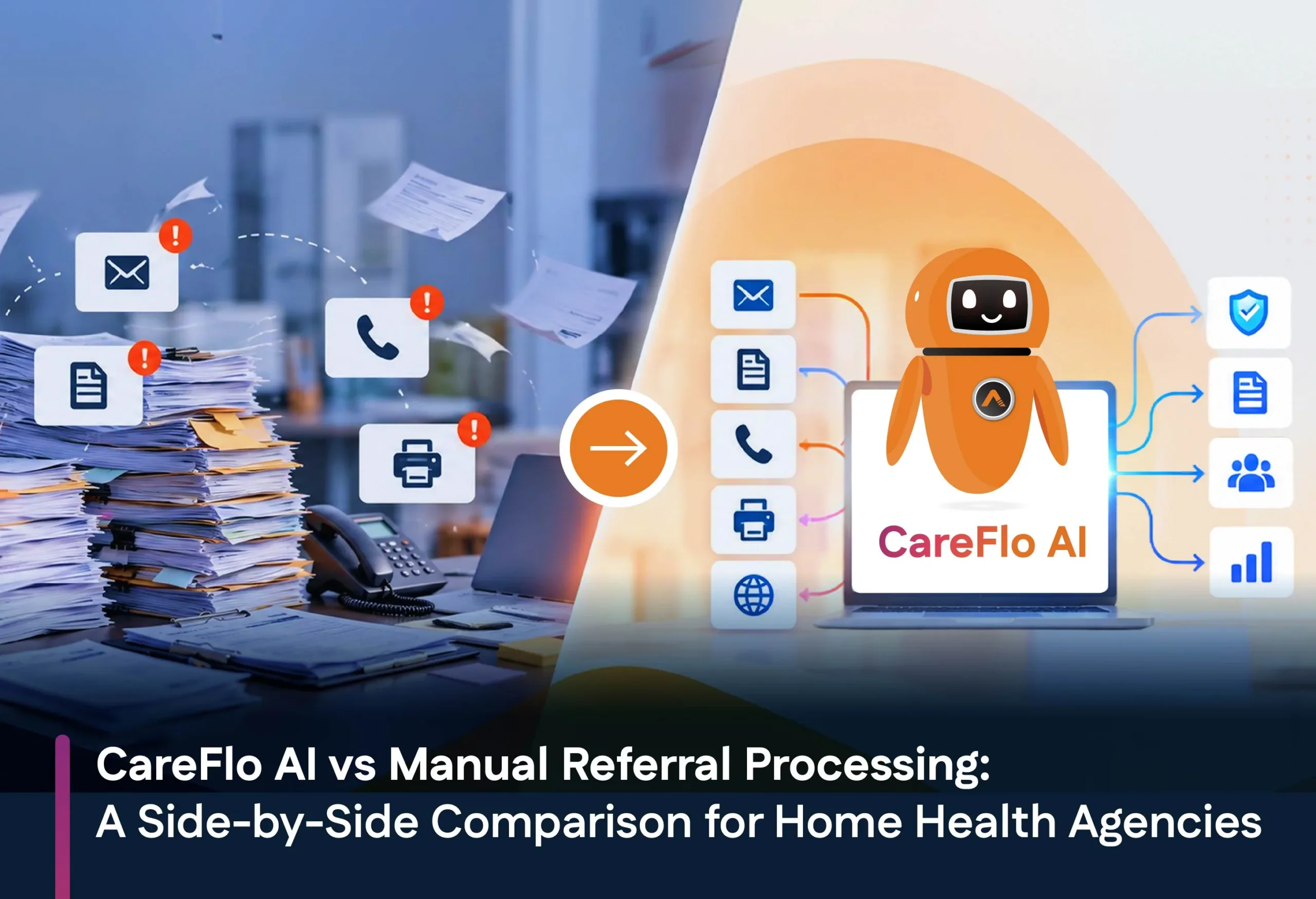
So, the question is : how to scale? Here you can see the side-by-side comparison of CareFlo AI vs. Manual Referral Processing and how a smart intake model can help your agencies turn more referrals into revenue.
Why Manual Referral Intake Process Fails in Home Healthcare Organizations
Referral intake process breakdowns in predictable ways once your agency scales and volume climbs. And a small coordinator cannot handle it all. Here are some ways it breaks down:
Multi-Source Fragmentation
In home healthcare, referrals arrive through multiple sources: fax, email, messaging, and referral portals through different systems and different branches. Without having a unified layer, intake coordinators are constantly chasing these referrals and logging into 5 or more portals per shift to see what’s coming in.
After Hour Blind Spot
Hospital discharge planners and SNF social workers don’t work 9-to-5, and referral sources routinely send the same case to multiple agencies at once. A manual team that closes at 6 p.m. is structurally unable to win the referrals that come in after that.
No Standardization Across Locations
At single-site agencies, one strong coordinator can paper over a lot of process gaps. At multi-location site agencies, the same reliance on individual judgement means intake quality varies from branch to branch. And leadership branch has no consistent way to see where referral leakage is happening right now.
Incomplete Data
An industry report stated that A referral is only valuable when it gives the care team the right information to understand the patient’s needs and act quickly.
A May 2026 systematic review in the British Journal of General Practice identifies four key elements of a quality referral: clear clinical reasoning, complete and relevant patient information, and fewer barriers to accessing care. In practice, referrals often miss one or more of these elements, making it harder for teams to triage patients, prepare care, and respond efficiently.
None of this reflects a bad team. It’s what happens when a process built for 10 referrals a month is asked to handle 200.
CareFlo AI vs Manual Referral Processing
| Step | Manual Referral Processing | CareFlo AI |
|---|---|---|
| Referral capture | Coordinators check fax, portals, and email separately, often per branch | All channels centralized into one intake workflow, across every location |
| Data extraction | Manually extracted from documents, line by line | AI extracts patient demographics, diagnosis, insurance, and physician details automatically |
| Insurance eligibility verification | Manual portal logins, often hours of delay | Verified in real time at the point of intake |
| EMR entry | Manual, batch-processed, prone to transcription error | Auto-populated directly into your EMR system or referral portals |
| Referral triage/routing | Judgment-based, varies by coordinator and branch | Rule-based routing by service area, payer type, diagnosis, and staffing availability |
| Response time | Roughly an hour or more per referral packet | Minutes, not hours |
| After-hours coverage | None. Referrals wait until the next business day | 24/7, so referral sources get a response regardless of when they send it |
| Consistency across locations | Depends on individual coordinators at each branch | Same workflow and data standards enforced everywhere |
The pattern holds regardless of agency size, but it compounds at scale: a single-site agency absorbs inconsistency with one good coordinator. A growing multi-branch agency is multiplying that inconsistency by every location, every shift, every referral source relationship.
What Change for Your Referral Intake Team
Picture a coordinator’s morning at a multi-branch agency running manual intake:

With CareFlo AI in place, that same coordinator:

That shift matters most on scale.
- A single coordinator can only manually process so many referrals per day.
- A growing multi-branch agency usually isn’t short on referral volume; it’s short on the throughput to act fast enough.
The lesson for larger, multi-branch agencies is simple:
Growth doesn’t just increase referral volume; it increases the need for intake capacity.
A coordinator can only process a finite number of referrals manually each day. As volume scales across branches, the bottleneck shifts from finding referrals to processing and responding to them fast enough. CareFlo AI addresses that constraint by automating repetitive intake work so teams can spend their time on exceptions, decisions, and patient-facing work rather than paperwork.
As Siva Juturi, AutomationEdge’s Co-Founder & Chief Customer Officer, puts it:
For an agency operating at scale, that vertical depth is the difference between a tool that needs to be adapted to home health and one that already understands it.
How Agencies at Scale Compare Platforms That Integrate with Their Existing EHR
For a larger agency, the decision rarely comes down to “should we automate.” It comes down to “can this integrate cleanly with what we already run.” That’s the real evaluation criteria for agencies comparing referral automation platforms:
- Does it push validated data directly into the EMR, or does it hand back a CSV someone still has to import by hand? A real integration removes work; a partial one just relocates it.
- Does it work across every EMR your branches use? Multi-location agencies frequently run different systems at different sites, whether from legacy acquisitions or regional preference. A platform that only integrates cleanly with one EMR forces a standardization project before it can deliver value.
- Does it preserve your existing workflow, or does it require retraining staff on a new system from scratch? Time-to-value matters more at scale; a platform that takes months to onboard across ten branches costs more in disruption than it saves in efficiency.
CareFlo AI is built to answer “yes” to all three:
- Home health & hospice care-native EMR integrations,
- Multi-branch deployment without a standardization overhaul
- Real-time push into the EMR rather than an export step.
What Makes CareFlo AI Different from Other?
Home health & hospice agency leaders evaluating the automation platform are often comparing CareFlo AI against the general referral intake software built for medical practices, specialty, and hospitals. And here distinction matters. Let’s see how and where Referral Intake CareFlo AI is different:
Built for Home Health & Hospice Compliance
Referral Intake CareFlo AI is not a generic workflow automation tool. Its workflow built around home health & hospice timing requirements like face-to-face documentation, notice of admission deadlines, and LUPA threshold rather than generic medical referral denial codes. With CareFlo AI you also get AI’s triage logic account for PDGM episode value.
Runs the full referral-to-admission lifecycle, not just intake.
Unlike other referral automation software which handles document capture and routing only. CareFlo AI extends through caregiver matching, EVV compliance tracking, and claims/RCM on one platform instead of a stack of point solutions.
EHR Agnostic by Design
Some enterprise referral automation software ties up their AI features on their own EMR portals system. But CareFlo AI sits on the top layer of any existing infrastructure, which makes implementation a lot easier. So now multi-branch agencies are not forced to standardize their systems first.
Vertical Focus Over Horizontal Breadth
General referral automation tools are built to serve any medical practice by sending or receiving referrals. CareFlo AI is built exclusively for home health, hospice, Palliative Care, and SNF which means fewer generic features you don’t need and deeper support for the ones that directly affect your census and revenue cycle.
Built for AI- Assisted Maturity, Not Just Centralization
Many referral automation platforms stops consolidating referral channels into a single queue, an improvement, but still a manual review process underneath. CareFlo AI goes further with 3 blocks working together:
- A centralized intake hub that unifies portals, faxes, and email into one view.
- AI’s intelligent triage that identifies referral type, prioritizes urgency, and routes automatically.
- AI-generated clinical snapshots that summarize diagnosis, orders, and risk factors so a coordinator reviews a summary instead of a stack of documents
Where Manual Referral Processing Still Hold Up
It’s worth being direct about this:
- Manual referral intake isn’t the wrong choice for every agency.
- If you’re receiving fewer than 10 referrals a month, operating in a single market with one dominant referral portal, or just getting started, a small, well-run manual process with a dedicated coordinator can still work.
- The math changes once volume, multi-branch complexity, or after-hours referral loss starts showing up as a pattern rather than an exception.