
Imagine an employee submits a request:
“I need to update my address, check my benefits, and request leave.“
A traditional HR chatbot can answer each question, provide relevant policy links, and direct the employee to the appropriate forms. While this improves self-service, it still leaves the employee responsible for completing multiple actions across different systems.
Today’s workforce expects something different:
“Can you get this done for me?“
This shift is driving the conversation around HR chatbot vs agentic HR automation. While HR chatbots have significantly improved employee self-service, answering questions is only one part of effective HR service delivery. Employees increasingly expect fast, personalized, and end-to-end resolution of their requests.
For HR teams, the challenge is equally important. They need to reduce repetitive tickets, improve service delivery, and eliminate manual effort without introducing yet another disconnected tool. This is where agentic HR automation is emerging as the next evolution of employee support.
The fundamental difference is simple:
HR Chatbot vs Agentic HR Automation: What’s the Difference?
An HR chatbot primarily provides conversational answers and information. Agentic HR automation goes several steps further by understanding employee intent, accessing enterprise systems, executing workflows, routing approvals, and managing exceptions when human intervention is required.
HR Chatbot vs Agentic HR Automation Comparison
| Capability | HR Chatbot | Agentic HR Automation |
|---|---|---|
| Answer HR Questions | ✓ | ✓ |
| Policy Lookup | ✓ | ✓ |
| Understand Employee Intent | Limited | ✓ |
| Retrieve Employee Information | Limited / Depends on Integration | ✓ |
| Execute HR Tasks | Limited | ✓ |
| Multi-Step Workflows | Limited | ✓ |
| Cross-System Orchestration | Limited | ✓ |
| Approval Management | Limited | ✓ |
| Exception Handling | Basic Escalation | Intelligent Escalation |
| End-to-End Resolution | Limited | ✓ |
It is important to note that not every chatbot or AI agent has identical capabilities. The actual functionality depends on integrations, permissions, workflow design, governance controls, and implementation maturity.
When evaluating HR chatbot vs AI agent, organizations should focus less on the user interface and more on what the platform can actually accomplish behind the conversation.
From Employee Questions to Completed Workflows
The easiest way to understand the difference between an HR chatbot and an AI agent is through a real-world employee request.
Employee Request
What a Traditional HR Chatbot Does
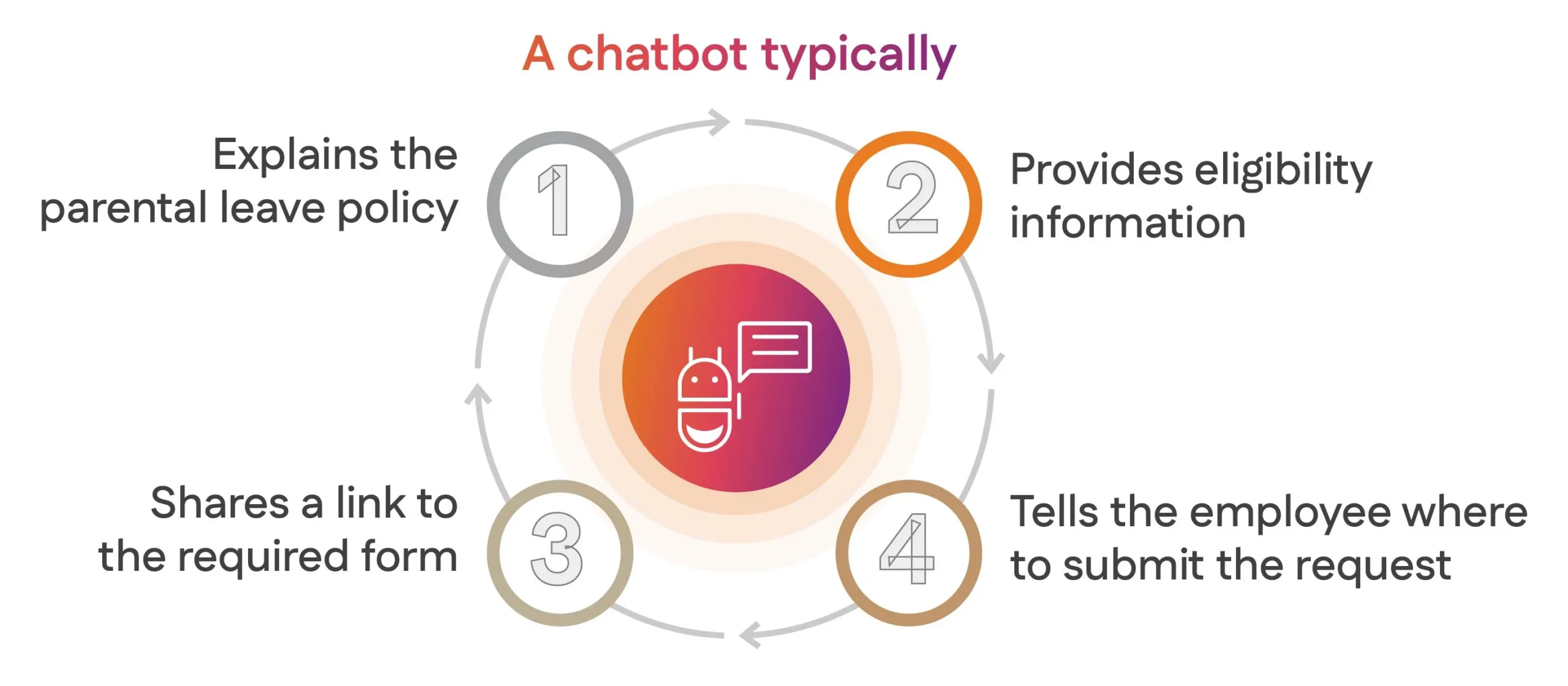
The employee still needs to perform the remaining tasks manually.
What Agentic HR Automation Does
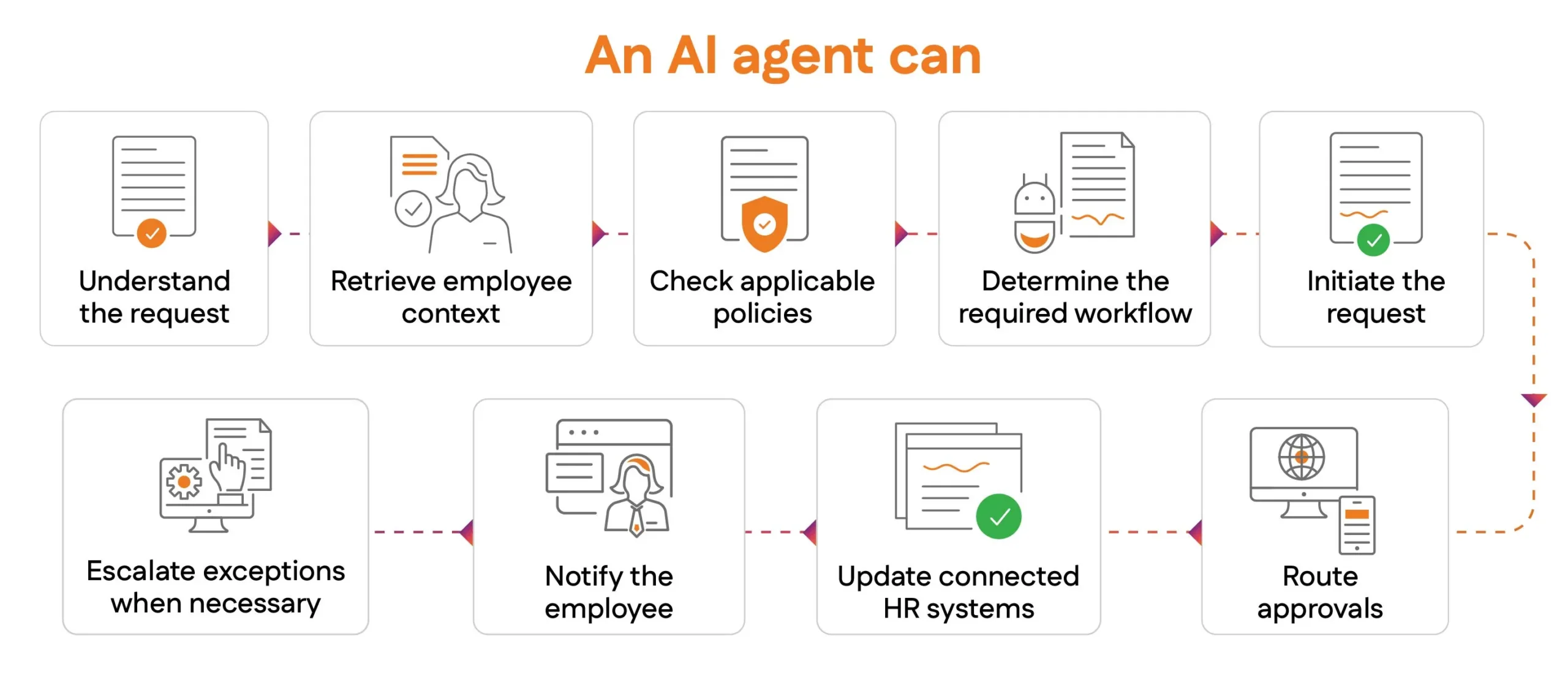
Instead of merely answering a question, the system actively works toward completing the request. The interface may still look like a chatbot. However, the value is created by the automation, orchestration, and workflow execution happening behind the conversation.
What Can Agentic HR Automation Actually Automate?
Many organizations assume AI agents are limited to answering questions. In reality, modern agentic systems can automate a wide range of HR service delivery processes.
Employee Self-Service
Common use cases include:
- HR policy questions
- PTO and leave requests
- Benefits inquiries
- Payroll-related questions
- Employee information requests
HR Service Requests
Agentic automation can streamline:
- Request intake
- Categorization
- Routing
- Status updates
- Resolution management
- Escalation handling
Employee Lifecycle Workflows
Organizations can automate:
- Employee onboarding
- Internal transfers
- Role changes
- Offboarding
- Access-related requests
Document and Data Workflows
AI agents can also support:
- Document collection
- Information extraction
- Validation
- HR record updates
The Key Distinction
| Chatbot | Agentic Automation |
|---|---|
| Helps employees navigate a process | Helps execute the process |
| Provides information | Performs actions |
| Supports self-service | Delivers resolution |
| Responds to questions | Orchestrates workflows |
Where HR Chatbots Still Make Sense
Despite the rise of autonomous HR automation, chatbots still deliver significant value in many scenarios.
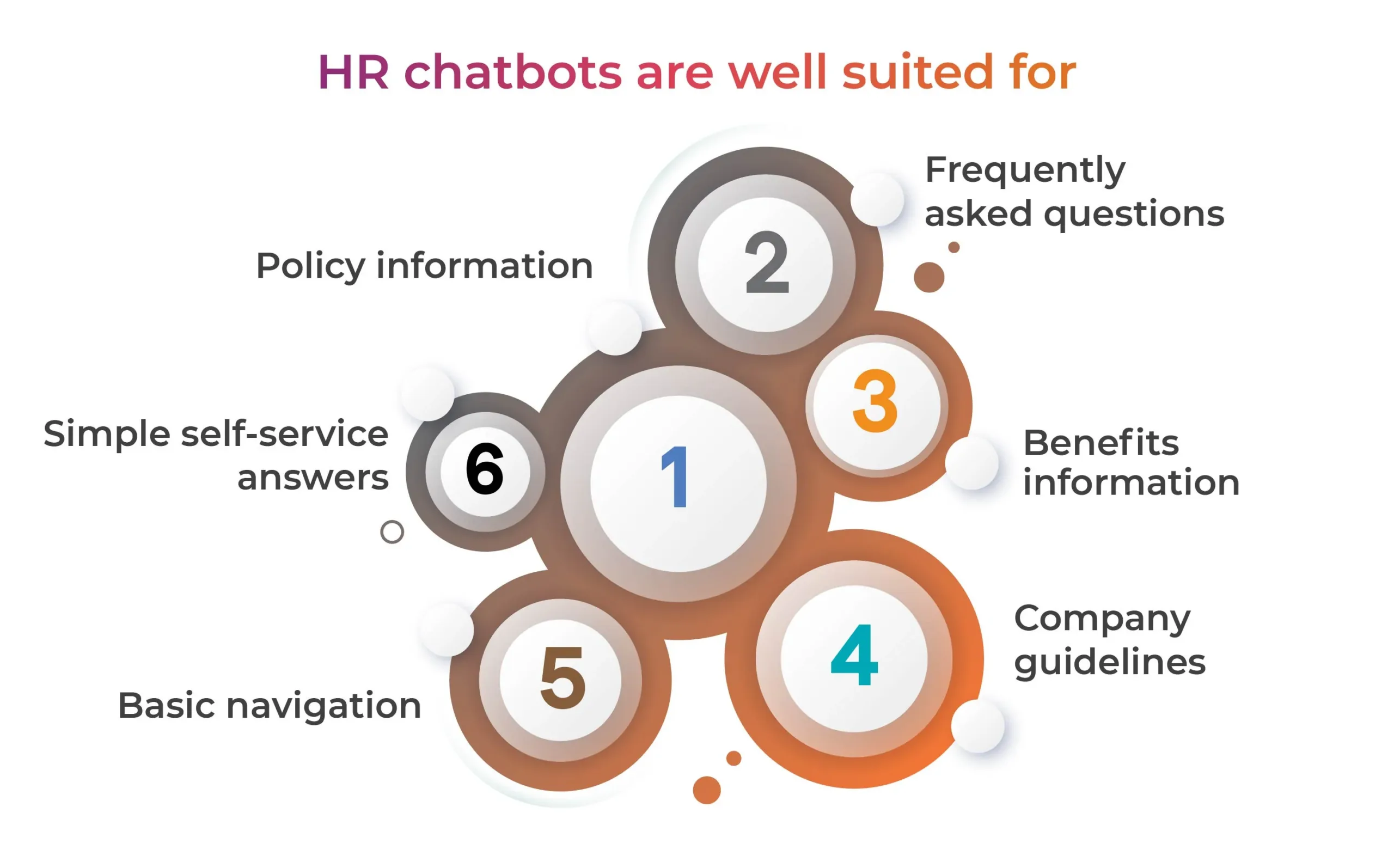
If employees primarily need information, a chatbot may be sufficient. However, when employees need actions completed rather than answers provided, organizations should evaluate AI agents and workflow automation capabilities.
When Enterprises Should Consider Agentic HR Automation
Organizations should evaluate agentic HR automation when they experience challenges such as:
- High volumes of repetitive HR requests
- Frequent employee inquiries requiring system lookups
- Manual HR workflows consuming significant time
- Requests moving across multiple enterprise systems
- Manual routing and approval bottlenecks
- Employees demanding real-time status visibility
- Difficulty scaling HR operations
- Pressure to improve ticket resolution metrics
The real question is no longer:
“Do we need an HR chatbot?”
The better question is:
“How much of the employee support workflow should AI actually resolve?”
8 Things to Evaluate in an Enterprise HR Automation Platform
Selecting an HR AI solution requires more than evaluating conversational capabilities.
Evaluation Checklist
| Evaluation Area | Key Question |
|---|---|
| Workflow Execution | Can it perform tasks rather than only generate responses? |
| Enterprise Integrations | Does it connect with HRIS, ITSM, payroll, identity systems, and business applications? |
| Security & Permissions | Can access and actions be controlled? |
| Human-in-the-Loop Controls | Can approvals be enforced for sensitive workflows? |
| Exception Handling | What happens when automation cannot safely proceed? |
| Auditability | Can HR teams see what happened and why? |
| Scalability | Can it support enterprise-scale employee volumes? |
| Cross-Functional Automation | Can HR workflows connect with IT and other departments? |
These capabilities often determine whether an HR automation platform can deliver measurable business outcomes.
One Platform, Two Departments: Connecting HR and IT
Employees do not experience HR and IT as separate departments. They experience a single employee lifecycle.
Example: New Employee Onboarding
| HR Workflow | IT Workflow |
|---|---|
| Employee record creation | Identity creation |
| Document collection | Application access setup |
| Supports self-service | Device provisioning |
| HR onboarding tasks | Permission assignment |
From HR Self-Service to Autonomous Resolution with SupportFlo
SupportFlo helps organizations move beyond basic HR self-service by connecting conversations with workflow automation.
Key capabilities include:
The goal is straightforward: help HR teams automate the work behind employee requests, not just answer questions.
HR Chatbot vs Agentic HR Automation: Which Should Your Enterprise Choose?
The answer depends on the complexity of employee requests and the level of automation your organization requires.
Choose an HR Chatbot When
Common use cases include:
- Most requests are informational
- Employees primarily need policy answers
- No system actions are required
- Workflows are simple
Consider Agentic HR Automation When
- Requests require actions
- Multiple systems are involved
- HR teams perform repetitive manual work
- Approval workflows are common
- Resolution requires multiple steps
- HR service delivery automation is a strategic goal
Final Decision Framework
| If Your Goal Is… | Choose… |
|---|---|
| Better HR search and self-service | HR Chatbot |
| Policy and FAQ support | HR Chatbot |
| Workflow execution | Agentic HR Automation |
| Multi-system orchestration | Agentic HR Automation |
| Automated resolution | Agentic HR Automation |
| Scalable HR service delivery | Agentic HR Automation |
If your objective is simply better access to information, a chatbot may be enough. If your objective is automated resolution, workflow execution, and scalable service delivery, agentic HR automation becomes the stronger choice.
Conclusion: The Future of Employee Support Is Resolution, Not Just Conversation
HR chatbots solved an important challenge by making information easier to access. Agentic HR automation addresses the next challenge: execution and resolution. Enterprise organizations should look beyond conversational interfaces and evaluate what happens behind the conversation.
The future of employee support is not simply an HR chatbot that knows the answer. It is an intelligent automation layer that can understand requests, execute workflows, connect enterprise systems, and involve people when judgment is required.
When HR and IT workflows operate through the same automation platform, employee support becomes an enterprise capability rather than another standalone departmental tool.