
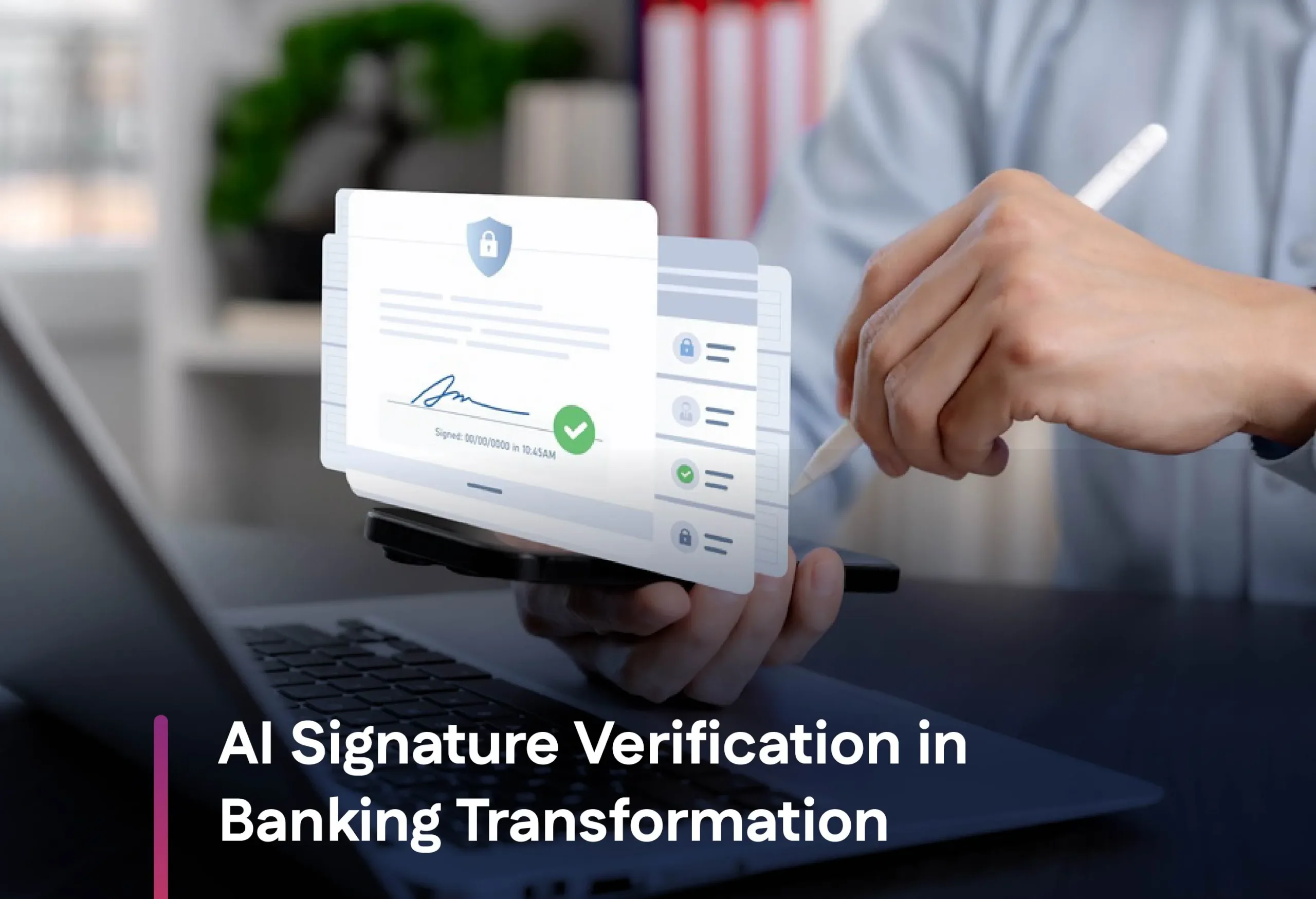
In today’s high-volume BFSI environment, signature matching automation powered by AI signature verification in banking is transforming how financial institutions ensure security, compliance, and speed. Traditional verification methods—manual or rule-based—are no longer sufficient in a world demanding real-time decisions and fraud resilience.
AI-driven systems bring precision, scalability, and consistency, enabling banks to validate signatures across millions of documents while significantly reducing fraud and operational overhead.
Why Earlier Digital Approaches Fell Short
Before the rise of AI, banks attempted to digitize signature verification using rule-based and image-processing techniques. While these methods marked progress, they struggled in real-world scenarios.
Extracting clean signature images from documents was a major hurdle. In practice, signatures often overlap with text, stamps, or lines, and may suffer from poor scan quality, skewed alignment, or inconsistent placement.
To compensate, systems relied on rigid preprocessing pipelines—normalizing brightness, removing noise, or isolating regions. However, these pipelines were fragile and broke easily when document formats varied.
Additionally, traditional signature recognition machine learning algorithms depended on manually engineered features such as stroke width, curvature, and slant. These approaches lacked adaptability and failed to generalize across diverse handwriting styles, leading to inconsistent accuracy.
Traditional vs AI-Powered Signature Matching Automation
| Aspect | Traditional Signature Verification | Automated Signature Verification (AI-Powered) |
|---|---|---|
| Method | Manual review or basic algorithms | Deep learning & automated signature recognition system |
| Handling Variations | Poor adaptability | Strong generalization across styles & formats |
| Speed & Scalability | Slow, human-dependent | Real-time, scalable to millions |
| Accuracy | 70–85%, subjective | 95–99%, objective and adaptive |
| Cost | High operational cost | Lower long-term cost |
| Fraud Detection | Limited capability | Advanced fraud prevention in banking using AI |
The Rise of AI: A New Era for Signature Validation
AI signature verification in banking is the use of deep learning and automated signature recognition systems to authenticate handwritten or digital signatures by analyzing patterns, stroke behavior, and historical data.
It helps banks reduce fraud, automate verification workflows, and improve accuracy up to 99%, replacing manual and rule-based verification systems.
These models automatically learn complex features such as:
- Stroke order and pressure patterns
- Micro-variations in handwriting
- Spatial relationships between signature components
This eliminates the need for manual feature engineering and significantly improves accuracy.
Most importantly, AI systems are resilient—they adapt to different document formats, lighting conditions, and capture methods without requiring redesign or manual tuning.
Challenges of Signature Verification Without AI
Without AI-powered signature matching automation, banks face multiple operational and security challenges:
- High manual effort leading to slow verification processes
- Inconsistent accuracy due to human errors and subjective judgment
- Limited fraud detection, especially against skilled forgeries
- Poor scalability when handling large volumes of documents
- Delays in onboarding and transaction approvals
These limitations make traditional and rule-based systems inefficient in today’s high-volume banking environment, highlighting the need for AI signature verification in banking.
How AI Signature Verification Works (Step-by-Step)
Below is a simplified step-by-step process of how it works:
-
Signature Capture
Signatures are captured from scanned documents, mobile uploads, or digital forms, enabling seamless digital signature verification for account opening.
-
Image Preprocessing
AI enhances the image by removing noise, correcting alignment, and standardizing formats—making it more reliable than traditional methods.
-
Feature Extraction
AI analyzes key elements like stroke patterns, pressure, and shape using signature recognition machine learning algorithms.

-
Signature Comparison
The system compares the signature with stored samples to verify authenticity, a core step in AI signature verification in banking.
-
Confidence Scoring & Decision
A match score is generated, and suspicious signatures are flagged—showing how AI detects signature fraud in banks.
-
Continuous Learning
The system improves over time by learning from new data, making signature matching automation more accurate and scalable.
How AI Improves Signature Verification in Banks
Signature verification in banks lies in its ability to analyze patterns in real time and detect anomalies that humans or rule-based systems would miss.
AI models:
- Compare signatures against historical samples using deep neural networks
- Assign confidence scores to each verification
- Flag suspicious deviations instantly
This capability is critical for high-risk workflows like loan approvals, Cheque processing, and mandate verification. Additionally, AI systems continuously learn from new data, improving accuracy over time without manual intervention.
How AI Detects Signature Fraud in Banks
A key advantage of signature matching automation is its ability to uncover subtle fraud patterns.
How AI detects signature fraud in banks:
- Identifies inconsistencies in stroke sequencing and flow
- Detects unnatural pen lifts or hesitations
- Compares signatures across multiple documents for behavioral mismatch
- Flags anomalies that deviate from a user’s historical signature profile
This makes AI highly effective in fraud prevention in banking using AI, especially against skilled forgeries that bypass manual checks.
Digital Signature Verification for Account Opening
Digital signature verification for account opening is a game-changer for customer onboarding.
Using AI signature verification for KYC and onboarding, banks can:
- Capture signatures via mobile apps or uploaded documents
- Validate them instantly using AI models
- Approve accounts without physical paperwork
This enables seamless digital KYC automation, reducing onboarding time from days to minutes while ensuring compliance.
Key Benefits: Reduce Banking Fraud with Signature Automation
-
Fraud Reduction
Banks can reduce banking fraud with signature automation by 65–80% through accurate anomaly detection and behavioral analysis.
-
Operational Efficiency
AI helps reduce paperwork with AI signature automation, eliminating manual verification and document handling.

-
Scalability
Automated systems handle millions of verifications simultaneously without human fatigue.
-
Compliance & Auditability
AI systems provide consistent, traceable decisions aligned with regulatory standards such as RBI guidelines.
-
Faster Turnaround Time
Example: A leading Indian bank reduced signature verification time by 90% after implementing AI-based automation.
How to Implement AI Signature Verification in Banks
Implementing signature matching automation in banking involves integrating AI-driven systems into existing verification workflows to improve accuracy, speed, and fraud detection.
Key steps include:
- Integrate with core banking systems to enable seamless data flow
- Train AI models on historical signature datasets for higher accuracy
- Deploy automated signature recognition system via APIs for real-time verification
- Enable AI-based fraud detection in banking workflows to flag anomalies instantly
- Continuously monitor and improve models using new data and feedback
This approach ensures scalable, secure, and efficient AI signature verification in banking, while supporting digital KYC automation and reducing manual effort.
Use Cases of Automated Signature Recognition System in Banking
The adoption of an automated signature recognition system is rapidly expanding across banking operations, enabling institutions to scale securely while improving efficiency and customer experience. Below are the most impactful use cases where signature matching automation delivers measurable value.
-
Loan Processing and Approval Workflows
Loan processing involves multiple stages of document verification, where signature validation is critical for authenticity.
With AI signature verification in banking, financial institutions can:- Instantly validate borrower signatures across application forms and agreements
- Detect inconsistencies across multiple submitted documents
- Automate approval workflows with confidence scoring
This significantly reduces turnaround time while strengthening fraud prevention in banking using AI, ensuring that forged applications are flagged early. -
Cheque Verification and Payment Authorization
Cheque fraud remains a persistent issue in traditional banking systems.
An automated signature recognition system enables:- Real-time signature verification during Cheque clearing
- Cross-validation against historical signature records
This is a direct example of how AI detects signature fraud in banks, identifying even subtle deviations in writing patterns that manual verification often misses. -
AI Signature Verification for KYC and Onboarding
Customer onboarding is one of the most document-intensive processes in banking.
Using AI signature verification for KYC and onboarding, banks can:- Validate signatures on identity documents instantly
- Ensure consistency across KYC forms
- Enable seamless digital KYC automation
This not only accelerates onboarding but also helps reduce paperwork with AI signature automation, improving both operational efficiency and customer satisfaction. -
Digital Signature Verification for Account Opening
Digital signature verification for account opening allows banks to offer fully remote onboarding experiences.
Customers can:- Upload or capture their signature via mobile devices
- Complete verification without visiting a branch
Behind the scenes, signature recognition machine learning algorithms analyze and authenticate the signature in real time. This enhances accessibility while maintaining strong compliance and security standards. -
Mandate and Agreement Verification (ECS/NACH)
Recurring payment mandates and agreements require reliable signature validation to prevent unauthorized transactions.
By leveraging signature matching automation, banks can:- Authenticate signatures on NACH/ECS mandates
- Prevent unauthorized debits
- Maintain audit trails for compliance
This strengthens fraud prevention in banking using AI and builds trust in automated payment systems. -
Trade Finance and High-Value Transactions
In trade finance, where transactions involve large sums and multiple documents, signature verification is critical.
AI-powered systems:- Validate signatures across contracts, guarantees, and letters of credit
- Detect anomalies across multi-document workflows
- Provide risk alerts for suspicious activities
This ensures that banks can reduce banking fraud with signature automation in high-risk, high-value scenarios. -
Internal Banking Operations and Audit Compliance
Beyond customer-facing processes, signature verification plays a role in internal approvals and audit trails.
With AI signature verification solutions for banks, institutions can:- Automate internal document approvals
- Ensure consistency in authorization workflows
- Maintain transparent, auditable verification logs
This improves governance while helping banks reduce paperwork with AI signature automation.
AI Signature Verification Solutions for Banks
AutomationEdge offers advanced AI signature verification solutions for banks as part of its hyperautomation platform.
Its bank signature verification software leverages:
- Deep learning-based automated signature recognition system
- Seamless integration with banking workflows
- Scalable architecture for high-volume processing
AutomationEdge addresses the limitations of legacy systems by delivering robust, adaptive systems that works across diverse document formats and environments.
With AutomationEdge, banks can:
- Reduce banking fraud with signature automation
- Improve customer experience through faster onboarding
- Achieve end-to-end digital KYC automation
- Significantly reduce paperwork with AI signature automation