
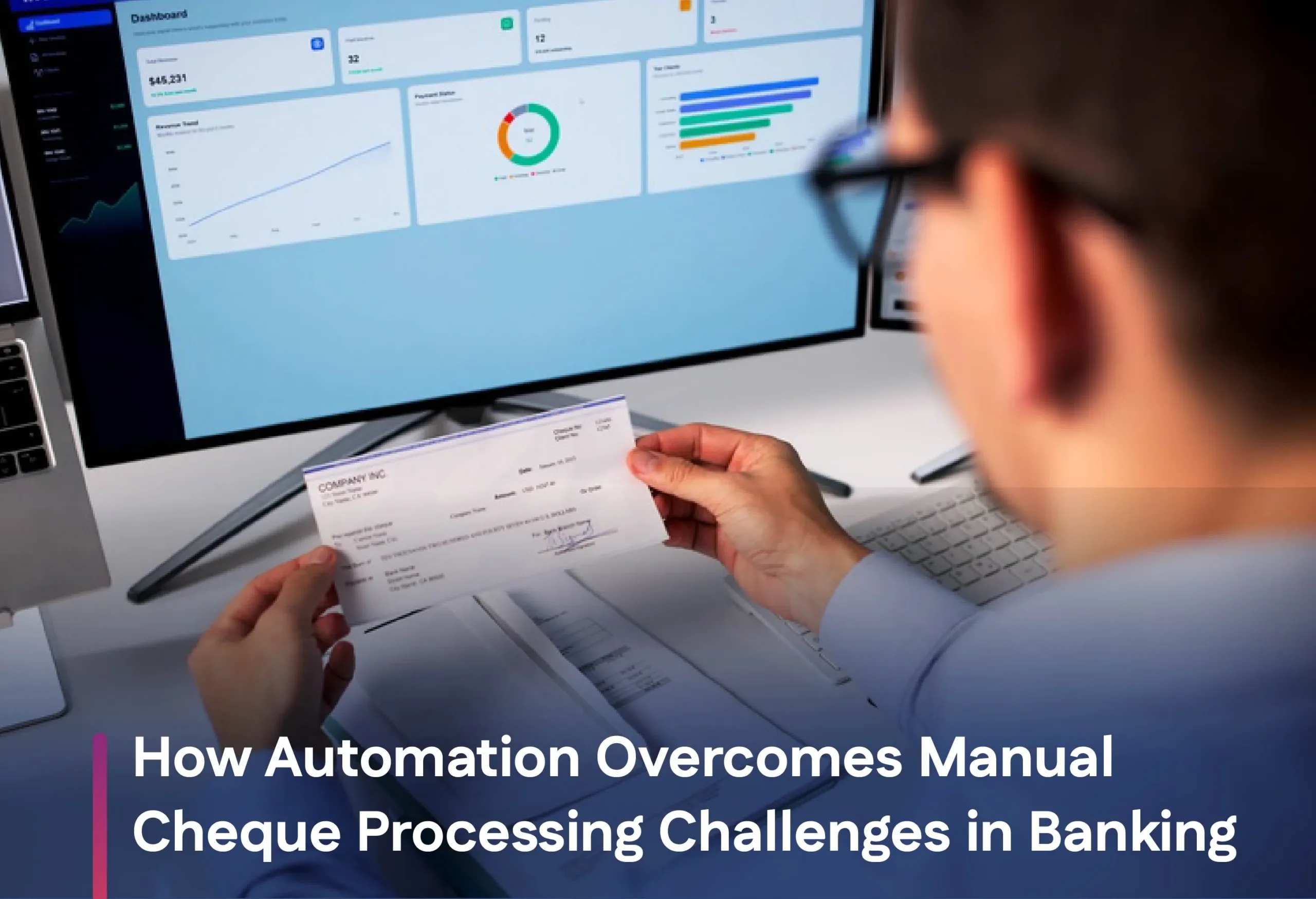
Despite rapid growth in digital payments, cheques continue to play a critical role in banking, especially corporate payments, government transactions, interbank settlements, and legacy customer segments. Yet the way cheques are processed in many banks has barely evolved.
Manual cheque handling still relies heavily on human effort: reading handwritten fields, entering data into systems, verifying signatures, and resolving exceptions. These steps introduce delays, inaccuracies, compliance risks, and operational costs that scale poorly as volumes increase.
This is why cheque data extraction automation has become a strategic priority for modern banks. By using AI-driven OCR and intelligent automation, banks can transform cheque processing from a slow, error-prone back-office function into a fast, accurate, and resilient operation that supports business growth.
What Is Cheque Data Extraction Automation?
Cheque data extraction automation is the automated process of capturing, interpreting, validating, and processing cheque information using artificial intelligence, without manual data entry.
At its core, it combines:
- AI OCR for banking documents to read printed and handwritten text
- Machine learning models to understand context and intent
- Business rules to validate extracted data
- Workflow automation to move cheques through clearing and settlement
This directly addresses long-standing manual cheque processing challenges, including slow turnaround times, inconsistent accuracy, and high dependency on skilled staff.
Where Banks Use Cheque Data Extraction Automation
Cheque data extraction automation supports multiple cheque touchpoints across retail and corporate banking. It standardizes processing, reduces manual workload, and improves speed and fraud control across channels.
Key use cases:
- Branch Capture: Instant cheque scanning and AI OCR-based data extraction at branch counters.
- Bulk Corporate Processing: High-volume cheque automation for faster reconciliation and posting.
- Centralized Processing Units: Scalable automated cheque processing across regions.
- Lockbox Operations: Automated mailroom cheque data capture for business receivables.
- CTS Clearing Hubs: Accurate MICR reading and secure data validation for settlement.
- Remote Deposit Capture (RDC): AI-based cheque validation via mobile or remote scanners.
This ensures faster TAT, reduced errors, and stronger cheque fraud detection across operations.
Manual vs AI Cheque Processing
Manual cheque handling relies heavily on human intervention, making it slow, error-prone, and costly. As volumes increase, operational pressure and fraud risks also rise.
With cheque data extraction automation, banks use AI OCR, validation engines, and fraud analytics to process cheques faster and more accurately. The result is improved TAT, lower costs, and stronger control across clearing operations.
| Parameter | Manual Cheque Processing | AI Cheque Data Extraction Automation |
|---|---|---|
| Data Entry | Manual keying of cheque details | AI OCR-based automated data capture |
| Accuracy | 5–10% error rate | 99%+ extraction accuracy |
| Turnaround Time | Slow, multi-step verification | Faster TAT with real-time validation |
| Fraud Detection | Visual/manual checks | Automated signature & anomaly detection |
| Cost | High cost per cheque | Up to 50% lower processing cost |
Why Cheque Data Extraction Automation Is Important for Banks
-
Manual Processing Is No Longer Scalable
As banks expand services, transaction volumes grow, but operational teams do not scale at the same pace. Manual cheque workflows struggle under this pressure, leading to:
- Backlogs during peak periods
- SLA breaches
- Increased reconciliation effort
-
Accuracy and Risk Are Business-Critical
Human data entry errors, especially with handwritten cheques, can lead to:
- Incorrect postings
- Payment delays
- Customer disputes
- Regulatory scrutiny
By using AI OCR for banking documents, banks dramatically improve data accuracy and consistency across cheque operations. -
Stronger Cheque Fraud Detection
Fraudsters exploit manual gaps. Automation strengthens cheque fraud detection by:
- Matching signatures against historical records
- Detecting altered amounts or overwritten fields
- Identifying duplicate or suspicious submissions
Combined with intelligent document processing for banks, automation creates a layered defense that manual review alone cannot match.
Key Components of Cheque Data Extraction Automation
-
AI-Based OCR Engine
Unlike traditional OCR, AI-powered OCR learns from variations in handwriting, fonts, layouts, and scan quality making it ideal for cheque documents.
-
Contextual Data Understanding
Automation doesn’t just read characters; it understands:
- Numeric vs written amounts
- Field relationships
- Document structure
This intelligence is what makes cheque data capture automation reliable at scale.

-
Validation & Business Rules
Extracted data is automatically validated against:
- Core banking systems
- Account master data
- Transaction rules
-
Fraud & Anomaly Detection
Advanced systems apply behavioral and visual analysis to enhance cheque fraud detection before settlement.
-
Workflow & Exception Handling
Exceptions are automatically routed to the right teams with full context eliminating manual follow-ups and delays.

How Cheque Data Extraction Automation Works (Step-by-Step)
- Image Acquisition & Preprocessing
The cheque is scanned or photographed, and the system enhances image quality by correcting skew, removing noise, and adjusting contrast. - Document Classification & Segmentation
The system identifies the cheque layout and segments it into regions of interest (ROI) like payee, date, amount, and signature. - Data Extraction (OCR/ICR)
OCR/ICR engines convert printed and handwritten cheque details into structured digital data. - Data Validation & Matching
CAR/LAR amounts are matched, MICR and account details are verified, and signatures are authenticated against records. - Exception Handling
Low-confidence or mismatched cheques are automatically routed for human review. - Data Export & Core Banking Integration
Verified data is transmitted to the core banking system for clearing, settlement, and final processing.
Benefits & ROI of Cheque Data Extraction Automation
Cheque data extraction automation delivers measurable value across operations, finance, and customer experience. By eliminating manual bottlenecks and improving data accuracy, banks accelerate clearing cycles while reducing operational costs. Automation also strengthens fraud controls and compliance confidence. The result is scalable growth, higher efficiency, and improved customer trust.
| Operational Benefits | Financial Benefits | Customer Experience Benefits |
|---|---|---|
| Significant reduction in manual effort | Lower cost per cheque processed | Faster funds availability |
| Faster clearing cycles | Reduced rework and exception handling costs | Fewer processing errors |
| Consistent processing quality | Improved utilization of skilled staff | Higher trust and satisfaction |
| Automated exception routing | Reduced fraud-related financial losses | Real-time status visibility |
| Improved compliance tracking | Lower infrastructure and processing overhead | Improved service reliability |
Over time, cheque data extraction automation delivers measurable ROI by improving throughput while controlling costs.
Future Trends in Cheque Processing Automation
Cheque processing is no longer just about digitizing paper, it is becoming part of a broader intelligent banking ecosystem. As financial institutions accelerate digital transformation, automation is shifting from rule-based task execution to AI-driven decision intelligence. The next wave of innovation will focus on autonomy, predictive capabilities, and unified document processing across banking operations.
The next phase of innovation will include:
| Trend | What It Means for Banks |
|---|---|
| Agentic AI Handling Exceptions Autonomously | AI systems will move beyond flagging discrepancies to making contextual decisions, automatically approving low-risk cases while escalating only high-risk exceptions to human reviewers. |
| Predictive Fraud Scoring | Advanced models will analyze historical patterns, behavioral data, and anomaly signals to proactively detect and prevent fraud before settlement occurs. |
| Unified Automation Across Cheques, Remittances, and Trade Documents | Banks will replace siloed systems with integrated platforms that process multiple financial document types through a single intelligent automation framework. |
| Real-Time Processing Integration | Cheque automation will align with real-time payment systems, reducing clearing windows and improving liquidity and cash flow management. |
| Continuous Learning Models | AI systems will continuously improve through feedback loops, enhancing extraction accuracy and strengthening fraud detection precision over time. |
As banks modernize operations, cheque data extraction automation will evolve beyond task automation into a fully autonomous processing layer capable of decision-making, risk assessment, and real-time optimization across the enterprise.
Why AutomationEdge for Cheque Data Extraction Automation
AutomationEdge delivers enterprise-grade cheque data extraction automation powered by advanced IDP and AI built specifically for banking environments. We help banks eliminate manual cheque processing challenges while improving speed, accuracy, compliance, and fraud control.
Why banks choose AutomationEdge:
- AI-driven data extraction for printed and handwritten cheque fields
- End-to-end intelligent document processing for banks from capture to CBS/CTS integration
- Built-in cheque fraud detection with signature verification and anomaly scoring
- Automated validation and smart exception workflows to reduce rework
- Secure, compliant, audit-ready architecture
- Rapid deployment with measurable ROI
With AutomationEdge IDP and AI, banks move from manual cheque handling to intelligent, scalable, and future-ready automation.
Conclusion
Manual cheque processing is a hidden operational risk that banks can no longer afford. With cheque data extraction automation, banks gain speed, accuracy, scalability, and stronger fraud controls, without increasing operational complexity. By combining AI, OCR, intelligent document processing, and workflow automation, cheque operations become resilient, compliant, and future-ready. AutomationEdge enables banks to deploy secure, scalable cheque automation that integrates seamlessly with core systems, helping institutions modernize cheque processing while protecting trust and profitability.