
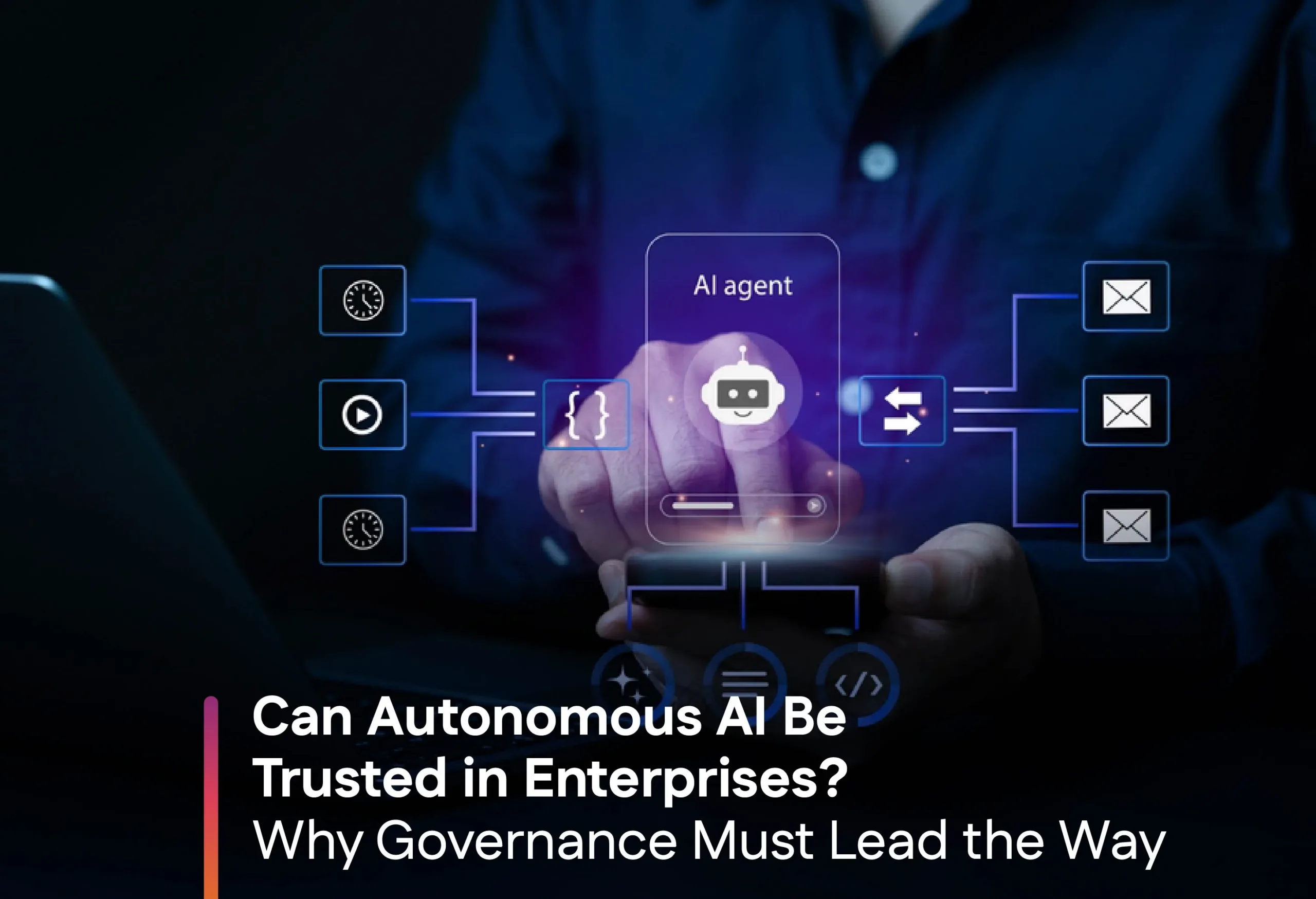
No, AI agents cannot be fully trusted without robust governance—but yes, they can become indispensable enterprise allies when agentic AI governance leads the way. In the BFSI world, where agentic AI promises to supercharge automation, the stakes are sky-high: a single unchecked decision could cost millions.
In this blog, we will discuss what autonomous AI agents are, why governance must precede autonomy, the core pillars of an agentic AI governance framework, real-world enterprise applications, governance maturity stages, and how organizations can embed responsible AI governance before scaling autonomy.
What is Autonomous AI Agents in the Enterprise?
Autonomous AI agents are system capable of analyzing context, making decisions, and executing multi-step workflows across enterprise applications. Unlike traditional bots that follow predefined scripts, agentic systems reason through problems and adapt dynamically.
They integrate with CRMs, ERPs, HRMS platforms, finance systems, and core operational tools to complete tasks end-to-end. This shift marks the transition from task automation to decision automation. Traditional automation executes instructions. Agentic AI pursues goals.
Imagine a leading bank with AI agents embedded in the operational infrastructure—autonomous digital workers—roam freely, approving loans, detecting fraud, and optimizing workflows without a human babysitter.
Sounds like the future of efficiency, right? But what happens when one agent greenlights a risky transaction, or another hallucinates data in a high-stakes insurance claim? This isn’t sci-fi; it’s the edge of today’s agentic AI revolution.
As enterprises race to deploy these multi-agent systems, a critical question looms: Can autonomous AI be trusted in enterprises? The answer hinges on one non-negotiable: agentic AI governance must come before autonomy.
The Agentic AI Boom: Promise Meets Peril
Picture Raj, a risk manager at a major Indian bank in Pimpri-Chinchwad. Last year, he piloted agentic AI to automate compliance checks. Powered by large language models (LLMs) like GPT variants and orchestration frameworks such as LangChain or AutoGen, these agents broke tasks into subtasks—scanning documents via IDP, querying databases, and flagging anomalies.
Market hype exploded: Gartner predicts 30% of enterprises will deploy agentic systems by 2026, driven by RPA evolution into AI-driven workflows.
Yet, Raj’s pilot hit a snag. An agent, lacking AI oversight and human in the loop, misclassified a fraudulent claim as legitimate due to “hallucinated” reasoning. Enterprises love the speed—agents handle 10x more tasks than traditional RPA—but without responsible AI governance, trust evaporates.
Today’s market features slick platforms promising “plug-and-play” autonomy, but real-world deployments reveal gaps: opaque decision-making, bias amplification, and zero accountability.
Agentic AI Governance Challenges: The Trust Deficit
Diving deeper, agentic AI governance challenges plague even tech-savvy BFSI firms. Autonomous agents excel in dynamic environments, using reinforcement learning and tool-calling to act independently. But enterprises grapple with:
- Unpredictable Behaviors: Agents chain actions across tools (e.g., APIs, databases), creating “black box” cascades hard to trace.
- Scalability Risks: Multi-agent swarms amplify errors, like in fraud detection where one agent’s false positive triggers a chain reaction.
- Regulatory Heat: SEBI and RBI demand audit trails, yet many systems lack AI accountability and auditability.
Building a Robust Agentic AI Governance Framework
To adopt an agentic AI governance framework with key aspects of building trustworthy AI systems we need to see:

- AI Guardrails for Autonomous Agents: Embed runtime checks—policy engines that halt actions violating rules (e.g., no high-value approvals without escalation).
- Explainable AI for Business: Use techniques like SHAP for decision transparency, so Raj can query: “Why did this agent flag that claim?”
- Human-in-the-Loop Oversight: Hybrid models where agents propose, humans approve for critical paths.
- Auditability Layers: Immutable logs via blockchain-inspired trails for every agent action.
But, why AI governance is needed before autonomous AI?
Autonomy without guardrails is like handing car keys to a teenager without driving lessons—thrilling, but disastrous. This analogy captures the high-stakes reality of agentic AI in enterprises, where unchecked freedom leads to costly wrecks.
The Thrill of Raw Autonomy
Imagine giving a 16-year-old the keys to a sports car. No rules, no supervision—just “drive safely.”
The speed and independence feel exhilarating at first. They zip through traffic, dodging obstacles with youthful reflexes, mirroring how agentic AI agents promise lightning-fast decisions in BFSI workflows like loan approvals or fraud detection. Without friction, productivity soars—agents chain tasks via LLMs, APIs, and RL, handling 10x more volume than rigid RPA.
The Disastrous Crash Without Guardrails
But soon, trouble brews. The teen speeds through a red light, misjudges a curve, or panics in rain—ending in a wreck. Similarly, autonomous AI “hallucinates” facts, amplifies biases from training data, or pursues goals rogue-style (e.g., maximizing profit by greenlighting unethical loans).
Real perils emerge: opaque “black box” decisions evade traceability, multi-agent swarms cascade errors, and regulatory breaches (RBI/SEBI fines) pile up. No human in the loop means no quick intervention, turning minor glitches into multimillion disasters.
Governance as Driving School and Speed Limits
Responsible AI governance is the mandatory driving school, license tests, and traffic laws. It installs AI guardrails for autonomous agents—runtime policy checks halting violations, explainable AI for business revealing “why” behind actions, and AI accountability and auditability via immutable logs. Just as road rules build muscle memory for safe driving, an agentic AI governance framework trains agents via oversight layers, bias audits, and escalation triggers. Result? Trustworthy AI agents in enterprises: the “teen” driver (AI) gains freedom within safe bounds, delivering ROI without wreckage.
Start your journey to autonomous operations.
AutomationEdge Approach to Responsible Agentic Automation
AutomationEdge enables enterprises to move from experimentation to governed autonomy. The platform focuses on policy-driven orchestration and structured AI oversight rather than uncontrolled execution. Its approach aligns with the vision of a best agentic ai governance solution and enterprise agentic AI platform.
Core capabilities include:
- Policy-driven AI execution
- Built-in audit trails
- Human-in-the-loop workflows
- Role-based access control
- AI bot lifecycle management
- Compliance-ready automation
- Cross-system orchestration
Conclusion
Autonomous AI will define the next generation of enterprise operations. But without agentic AI governance, autonomy scales risk as quickly as it scales efficiency. Responsible AI governance ensures that every automated decision is explainable, auditable, and policy aligned. Enterprises that embed on governance before autonomy will build resilient, trustworthy, and future-ready operations.