
IT automation for system integrators is no longer optional. It is a growth enabler. As enterprises scale across hybrid IT environments, system integrators (SIs) face a surge in repetitive IT tickets, alerts, and incidents. Manual handling slows response time, increases MTTR, and impacts customer satisfaction.
Today, IT automation for system integrators combined with AI automation for system integrators is transforming how IT services are delivered. By automating ticket triage, incident resolution, and alert management, SIs can reduce IT ticket volume by up to 60% while improving SLA performance.
This blog explains how AI-driven IT automation helps SIs cut ticket volume, resolve L1 and L2 tickets automatically, and scale operations efficiently. It also explores real-world use cases like intelligent ticket triage, automated incident resolution, and predictive ticket prevention. You’ll learn how system integrators can reduce MTTR, improve SLA compliance, and deliver AI-powered managed services at scale.
What Is AI Automation for System Integrators?
AI automation for system integrators refers to using AIOps, ITSM automation and rule-based automation to manage IT operations with minimal human intervention. It connects ITSM tools, monitoring systems, and infrastructure platforms into a single automated workflow.
Key capabilities include:
- Automated ticket creation and classification
- Intelligent ticket triage for system integrators
- Automated incident resolution for SIs
- IT alert automation system integration
- Predictive ticket prevention for enterprise IT
Instead of reacting to issues, SIs can proactively manage IT operations using AI-driven insights.
AI-Driven System Integrators vs Traditional System Integrators
AI-driven system integrators leverage automation and intelligence to deliver faster, proactive, and scalable IT services. Traditional SIs rely heavily on manual processes, making it harder to manage growing ticket volumes and complex environments. As enterprise IT becomes more dynamic, AI-driven models outperform traditional approaches in efficiency, cost control, and service quality. This shift is redefining how modern system integrators operate and compete.
Key Differences Between AI-Driven and Traditional System Integrators
| Area | Traditional System Integrators | AI-Driven System Integrators |
|---|---|---|
| Ticket Handling | Manual triage and resolution | Automated ticket triage and resolution |
| Incident Response | Reactive support model | Proactive and predictive issue handling |
| MTTR | Higher due to manual processes | Significantly lower with AI automation |
| Ticket Volume | High L1/L2 ticket load | 40–60% ticket reduction |
| Scalability | Requires more engineers to scale | Scales without increasing headcount |
| SLA Compliance | Inconsistent SLA performance | Improved and predictable SLA adherence |
| Service Differentiation | Standard managed services | AI-powered, intelligent managed services |
Why System Integrators Face High IT Ticket Volume
System integrators operate complex, multi-client IT environments. Each client uses different tools, infrastructure, and service models. This complexity leads to high ticket volumes.
Common reasons include:
- Multiple monitoring tools generating noisy alerts
- Manual ticket triage and assignment
- Repetitive L1 and L2 IT issues
- Lack of predictive incident prevention
- Siloed ITSM and monitoring systems
Without automation, support teams spend most of their time on repetitive tasks instead of value-added services.
How AI Automation Reduces IT Ticket Volume
AI automation analyzes alerts, historical tickets, and system behavior in real time to decide whether an issue actually needs human attention. By resolving repetitive problems automatically and stopping noise at the source, system integrators can focus on support teams only on high-impact incidents.
It reduces ticket volume by:
- Filtering false alerts using AI correlation
- Auto-resolving known issues before ticket creation
- Applying AI automation for IT ticket reduction
- Routing tickets intelligently to the right team
- Preventing incidents through predictive analytics
With AI-driven workflows, only actionable and complex tickets reach human engineers.
Example: In an enterprise IT department, AI automation monitors servers and applications continuously. When a service slows down, AI correlates alerts, executes predefined remediation steps, and resolves the issue automatically preventing multiple L1 tickets from end users and reducing overall ticket volume.
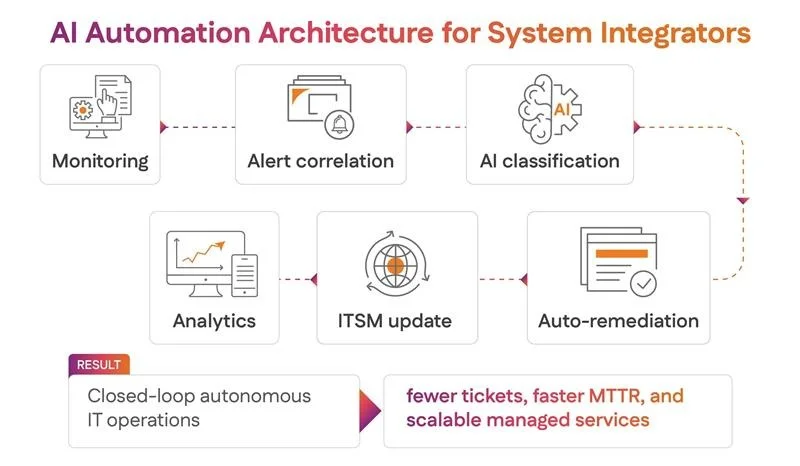
AI Automation Architecture for System Integrators
AI automation architecture brings monitoring, AIOps, remediation, and ITSM into a unified, closed-loop execution model. It continuously ingests alerts from hybrid infrastructure, applies intelligent correlation and classification, and triggers automated remediation before incidents escalate. Every action is updated back into the ITSM system, creating a self-learning feedback loop. This closed-loop, self-healing architecture reduces alert noise, prevents duplicate tickets, and enables predictive ticket prevention for enterprise IT. System integrators gain autonomous IT operations that cut ticket volume, lower MTTR, and scale managed services without increasing headcount.
Automation Use Cases for System Integrators
-
IT Ticket Automation Solutions
AI-powered ticket automation handles repetitive service desk tasks.
Key use cases:
- Auto-classification and prioritization of tickets
- Intelligent ticket triage for system integrators
- Automated assignment based on skill and workload
- Duplicate ticket detection and closure
-
Automated Incident Resolution for SIs
Automation resolves incidents without manual intervention.
Examples:
- Restarting failed services
- Clearing disk space automatically
- Resetting passwords
- Auto-remediation scripts for known errors
-
IT Alert Automation System
Alert automation reduces noise and improves response time.
Benefits:
- Alert correlation across tools
- Root cause identification
- Automated remediation actions
- Reduced alert fatigue
Expected Results: How Much Ticket Reduction SIs Can Achieve
AI helpdesk automation for system integrators quickly streamlines service desk operations by eliminating repetitive tasks and reducing alert noise. As automation learns from historical data and live incidents, support teams see faster resolutions and fewer tickets reaching engineers.
Typical results include:
- Reduction in IT ticket volume
- Faster MTTR improvement
- 24/7 automated incident handling
- Improved SLA compliance
- Lower operational costs
These results allow SIs to scale support without increasing headcount.
How to Implement AI Automation as a System Integrator
System integrators should begin AI automation by aligning technology with operational goals. A phased, use-case–driven rollout ensures faster adoption, minimal disruption, and measurable outcomes across client environments.
Key steps:
- Identify high-volume ticket categories
- Integrate ITSM and monitoring tools
- Define automation and remediation workflows
- Apply AI models for ticket prediction
- Monitor performance and optimize workflows
Starting with L1 and L2 tickets delivers the fastest ROI.
How AI Resolves L1 and L2 IT Tickets Automatically
L1 and L2 tickets are repetitive, rule-based IT issues such as password resets, service restarts, disk cleanup, and access provisioning that can be resolved using automation workflows.
These tickets are typically repetitive, rule-based, and ideal for automation. AI analyzes incoming alerts and ticket data to identify patterns, determine the correct resolution, and trigger automated actions instantly. This removes manual intervention while maintaining consistency and accuracy across IT operations.
AI resolves them automatically by:
- Detecting issues in real time
- Mapping alerts to known resolutions
- Executing remediation scripts
- Updating and closing tickets automatically
- Learning from historical data to improve accuracy
This approach significantly reduces manual effort and response delays.
Why System Integrators Need IT Automation Today
Client expectations are rising. SLAs are stricter. IT environments are more complex. Enterprises now expect proactive support, zero downtime, and faster response times across hybrid and cloud environments. Manual service models struggle to meet these demands at a scale. IT automation enables system integrators to standardize service delivery, improve consistency, and meet aggressive SLAs without increasing operational costs.
System integrators need automation to:
- Deliver faster incident resolution
- Scale services profitably
- Reduce dependency on manual support
- Offer differentiated managed services
- Stay competitive in global markets like the USA and India
Without automation, SIs risk operational inefficiency and margin erosion.
Best Automation Tools for System Integrators to Cut IT Tickets
Choosing the right automation tool directly impacts ticket reduction, MTTR, and service scalability. System integrators need platforms that go beyond basic scripting and support AI-driven decision-making. The right tool should integrate seamlessly with existing ITSM and monitoring systems while supporting multi-client environments. Without a robust automation platform, ticket volumes continue to grow and operational costs rise.
What to Look for in an Automation Tool
| Capability | Why It Matters for System Integrators | Business Impact |
|---|---|---|
| AI-Based Ticket Triage | Automatically classifies and prioritizes tickets | Faster response and reduced manual effort |
| IT Alert Automation System | Correlates alerts and removes noise | Fewer unnecessary tickets |
| Pre-Built Remediation Workflows | Enables instant auto-resolution of known issues | Lower MTTR and higher efficiency |
| Multi-Client Scalability | Supports multiple customers from one platform | Profitable service scaling |
| Analytics and Reporting | Tracks ticket reduction and SLA performance | Data-driven optimization |
How AutomationEdge Helps System Integrators Cut IT Tickets by 60%
AutomationEdge is an end-to-end AI automation platform purpose-built for System Integrators (SIs) delivering managed IT services at scale. By combining intelligent ticket triage, AI-driven alert correlation, predictive insights, and automated incident resolution, AutomationEdge helps SIs reduce IT ticket volumes by up to 60% while improving service quality and operational efficiency.
With enterprise-grade scalability, deep analytics, and seamless ITSM integration, AutomationEdge enables system integrators to differentiate their offerings, lower operational costs, and consistently meet SLAs across global client environments.
Key Capabilities That Drive Ticket Reduction
| AutomationEdge Capability | Impact for System Integrators |
|---|---|
| Intelligent ticket triage | Automatically classifies, prioritizes, and routes tickets |
| AI-driven alert correlation | Reduces alert noise and prevents duplicate tickets |
| Automated incident resolution | Resolves recurring issues without human intervention |
| Predictive ticket prevention | Identifies and fixes issues before tickets are raised |
| ITSM tool integration | Works seamlessly with ServiceNow, BMC, Jira, and more |
Conclusion
IT automation for system integrators is the foundation for scalable, efficient IT service delivery. By leveraging AI automation for system integrators, SIs can reduce ticket volume, improve MTTR, and enhance client satisfaction. With intelligent ticket triage, automated incident resolution, and predictive prevention, system integrators can move from reactive support to proactive service excellence. The future of IT services belongs to automation-driven system integrators.
“System integrators that adopt AI-driven IT automation move from reactive support to autonomous managed services, improving margins, scaling faster, and winning high-value enterprise deals.”