
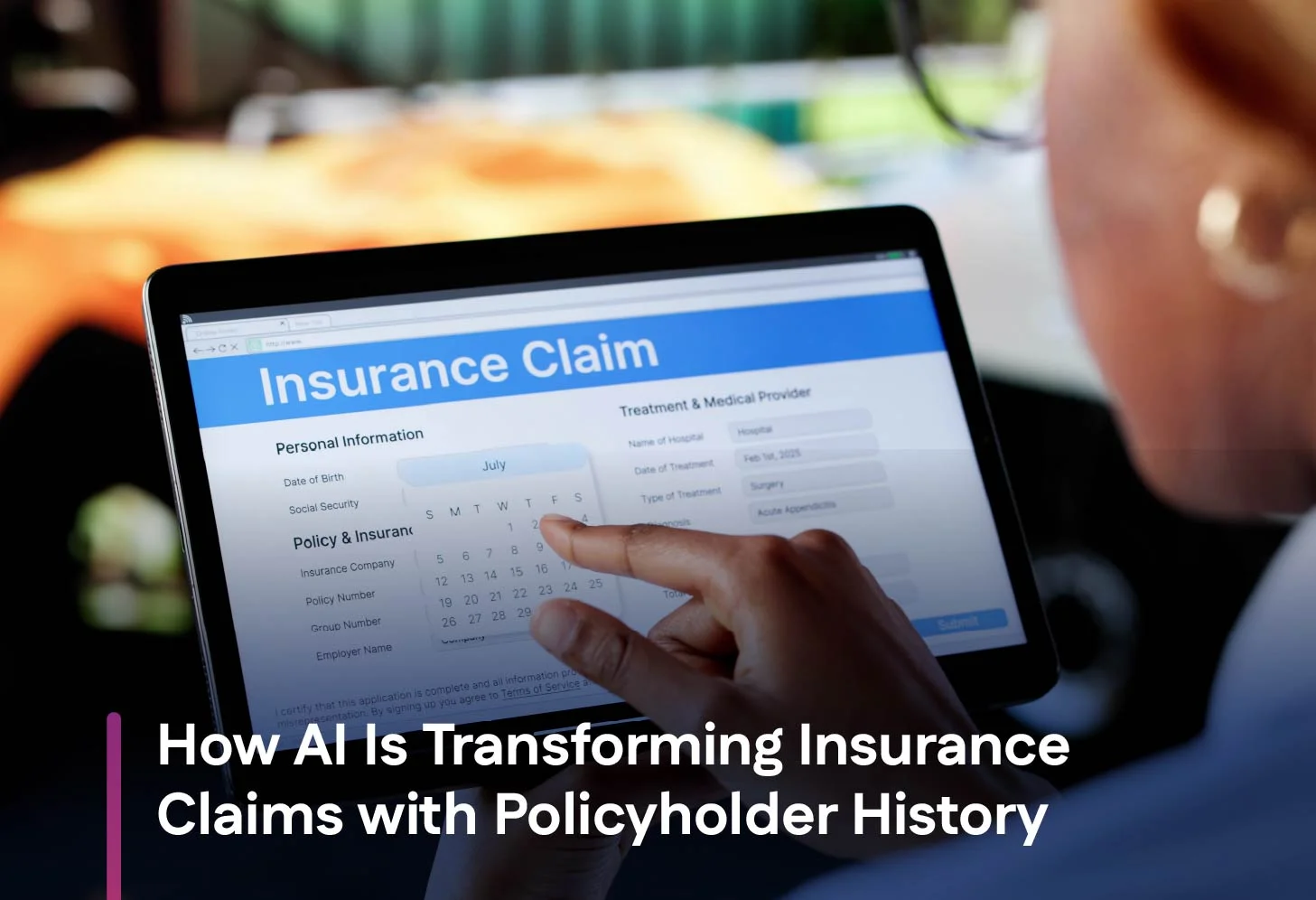
Insurance claims should be fast, simple, and personalized but in reality, they are often slow and frustrating. Traditional claims processes rely heavily on manual verification and generic workflows, leading to delays and poor customer experiences across the insurance customer journey.
At the same time, customer expectations are changing. Policyholders now expect digital-first, personalized interactions similar to what they experience in banking or e-commerce. However, insurers still struggle with fraud risks, repetitive documentation, and inconsistent decision-making, impacting the overall insurance customer journey.
What is AI-Powered Personalized Insurance Claims Processing?
AI-powered personalized insurance claims processing uses advanced technologies to analyze historical claims data, policyholder behavior, and risk patterns. Instead of treating every claim the same, AI tailors decisions based on individual customer profiles.
This approach improves accuracy, reduces delays, and enhances the overall policyholder experience.
Traditional vs AI-Driven Claims Processing
| Aspect | Traditional Claims | AI-Powered Claims |
|---|---|---|
| Approach | Generic | Personalized |
| Processing Speed | Slow | Fast |
| Decision Making | Manual | Data-driven |
| Fraud Detection | Reactive | Proactive |
| Customer Experience | Inconsistent | Seamless |
AI leverages past interactions, claims history, and behavioral insights to make faster and more informed decisions. This is the foundation of hyper-personalization in insurance.
Why Traditional Claims Processing Fails Customers
Despite technological advancements, many insurers still rely on legacy systems. These systems are not designed for speed, personalization, or scalability. As a result, customers face delays, repetitive steps, and inconsistent service.
Key challenges include:
- Long approval times: Claims often take days or weeks due to manual processing
- Repetitive document requests: Customers are asked for the same information multiple times
- Generic claim handling: No personalization based on customer history
- Poor customer experience: Lack of transparency and slow responses
- High fraud risk: Limited ability to detect complex fraud patterns
- Manual verification issues: Human errors and inefficiencies slow down processes
These challenges highlight the need for automating insurance claims using customer history and intelligent systems.
How AI Personalizes Insurance Claims Using Policyholder History
This is the most important shift in the insurance customer journey. AI uses policyholder insights and historical claims data to deliver tailored experiences and faster decisions.
-
Claim History Analysis
This is the most important shift in the insurance customer journey. AI uses policyholder insights and historical claims data to deliver tailored experiences and faster decisions.
- Identifies past claim frequency and patterns
- Detects anomalies based on historical data
- Enables faster approvals for low-risk customers
-
Personalized Risk Assessment
AI creates dynamic risk scores using real-time and historical data. This improves decision accuracy and reduces dependency on manual evaluation.
- AI-based risk scoring models
- Real-time decision-making
- Behavioral analysis for better insights
-
Smart Fraud Detection
Fraud detection becomes more accurate with AI-driven pattern recognition. It uses past fraud cases and behavioral signals to detect suspicious activities.
- Identifies unusual claim patterns
- Detects inconsistencies in data
- Uses historical fraud indicators for prediction
-
Personalized Communication & Customer Experience
AI enhances communication by tailoring interactions based on customer preferences and past behavior. This improves engagement and satisfaction.
- Automated claim status updates
- Personalized communication channels
- Faster and more relevant responses
-
Faster Claims Settlement
AI enables intelligent workflow automation, reducing manual intervention and speeding up approvals. This results in a smoother claims experience.
- Automated approvals for low-risk claims
- Reduced manual processing
- Faster end-to-end claims settlement
Discover how insurers are scaling intelligent automation to improve efficiency, reduce costs, and enhance customer experience with an advanced insurance claims AI solution
How AI Personalizes Insurance Claims (Step-by-Step)
AI personalizes insurance claims by analyzing policyholder history, behavior, and risk patterns to automate decisions, detect fraud, and accelerate claim approvals.

-
Data Collection & Integration
AI gathers data from multiple sources, including past claims, policy details, customer interactions, and third-party databases.
-
Policyholder Behavior Analysis
AI analyzes historical claims patterns, frequency, and behavioral signals.
-
Risk Scoring & Segmentation
AI assigns dynamic risk scores using predictive analytics.
-
Fraud Detection & Anomaly Identification
AI compares current claims with historical fraud patterns.
-
Decision Automation
AI automates approvals for straightforward claims using predefined rules and machine learning models.
-
Personalized Communication
AI tailors updates, notifications, and interactions based on customer preferences and history.
-
Continuous Learning & Optimization
AI models continuously learn from new data and outcomes.
Benefits of Personalized Insurance Claims Processing
AI-driven personalization delivers both operational and customer-focused benefits. It transforms claims from a slow process into a seamless experience..
Key benefits include:
- Faster claim approvals
- Better customer satisfaction
- Reduced operational costs
- Improved fraud detection
- Higher claims accuracy
- Personalized policyholder experience
- Scalable insurance operations
Real-World Use Cases of AI in Insurance Claims
AI is already being used across different types of insurance claims to improve efficiency and outcomes.
- Health insurance claims automation for faster approvals
- Motor insurance claims with AI-based damage assessment
- Property claims processing using document automation
- Fraud detection systems for high-risk claims
These use cases show how AI personalizes insurance claims at scale.
For Example:
A motor insurance company uses AI to process claims based on each driver’s history, behavior, and past claims.
Instead of following the same steps for every claim, AI customizes the process:
- Safe drivers with clean claim history get instant or same-day approvals
- High-risk drivers or frequent claimants go through additional verification checks
- Returning customers don’t need to upload documents again AI retrieves past data automatically
- AI-based image recognition assesses vehicle damage and estimates repair costs instantly
- Claims are prioritized differently based on urgency, history, and risk profile
- Communication is personalized customers get updates via app, SMS, or email based on preference
Result:
- Faster approvals for low-risk drivers
- Reduced paperwork and manual effort
- More accurate fraud detection
- A smoother, personalized claims experience
Technologies Behind AI-Powered Claims Personalization
Multiple technologies work together to enable personalized claims processing. Each plays a specific role in improving speed, accuracy, and decision-making.
- Machine Learning: Learns from historical claims data and improves predictions
- Natural Language Processing (NLP): Understands and processes customer communication
- OCR / Intelligent Document Processing (IDP): Extracts data from claim documents automatically
- Predictive Analytics: Forecasts risks and outcomes
- Generative AI: Enhances communication and decision support
- Workflow Automation: Automates end-to-end claims processes
- Decision Intelligence: Enables smarter and faster decision-making
Challenges in AI-Based Insurance Personalization
While AI offers significant benefits, insurers face challenges in implementation. These challenges must be addressed for successful adoption.
Common challenges include:
- Data privacy concerns
- Legacy system limitations
- Complex compliance requirements
- Risk of biased AI models
- Integration challenges
Best Practices for Implementing AI in Insurance Claims
A structured approach is essential for successfully implementing AI in claims processing.
Best practices include:
- Start with high-volume claims workflows
- Use clean and structured policyholder data
- Integrate AI with core insurance systems
- Combine automation with human oversight
- Choose scalable AI automation platforms
These steps help insurers maximize the value of AI in insurance claims.
Future of Hyper-Personalized Insurance Claims
The future of claims processing lies in hyper-personalization powered by AI and real-time data. Insurers will move beyond reactive claims handling to predictive and proactive service models.
AI will enable:
- Real-time claim approvals based on dynamic risk scoring
- Proactive claim suggestions based on customer behavior
- Fully automated, touchless claims journeys
- Personalized policy recommendations during claims interactions
This evolution will redefine the insurance customer journey, making it faster, smarter, and more customer centric.
How AutomationEdge Helps Insurers Personalize Claims Processing
AutomationEdge enables insurers to transform their claims operations with AI-powered automation. It provides a unified platform to improve efficiency, accuracy, and customer experience.
Key capabilities include:
- AI-powered automation for claims workflows
- Intelligent document processing
- Faster claims approvals and settlements
- Fraud detection and risk analysis
- Enhanced customer experience
- Seamless integration with insurance systems

Conclusion:
AI is transforming insurance claims from a slow, reactive process into a personalized, and intelligent experience. By leveraging policyholder history and behavioral insights, insurers can make faster and more accurate decisions. This shift not only improves customer satisfaction but also enhances operational efficiency and fraud detection. As the insurance industry continues to evolve, adopting AI-driven personalization will be key to staying competitive in a digital-first world.