
Introduction
Conversational IVR represents a transformative shift in voice-based automation, enabling natural, human-like interactions for seamless support. This technology powers 24/7 employee assistance through AI-driven voice bots, reducing dependency on live agents. In today’s fast-paced work environment, employees demand instant access to information—whether it’s resetting a password at 2 AM, checking HR policies during a night shift, or getting IT help mid-project. Conversational IVR delivers exactly that: seamless, AI-powered IVR systems that provide round-the-clock employee support automation without human intervention.
The voice bot for employee support handles routine queries instantly, reduces downtime, boosts productivity, and cuts costs by deflecting up to 50% of tier-1 tickets from overburdened teams. By enabling natural voice interactions anytime, conversational IVR transforms employee support into a frictionless experience, ensuring your workforce stays empowered and focused on high-value tasks.
Current Scenario of Conversational IVR
The conversational IVR market is exploding, valued at USD 17.4 billion in 2025 and projected to reach USD 56.9 billion by 2032 (18.5% CAGR), driven by AI adoption in contact centers. Involvement of conversational IVR is surging: 50% of businesses now deploy AI-driven systems, with 30% growth in voice assistants and 67% higher customer satisfaction vs. traditional IVR.
In employee support, voice bots for employee support handle 60%+ containment rates, processing 10M+ calls monthly across 100+ languages—replacing 100K+ live agents while achieving 95% resolution for routine queries like IT/HR assistance. BFSI leads adoption for compliance and 24/7 scalability.
What is Conversational IVR
Conversational IVR leverages natural language processing (NLP), speech recognition, and machine learning to enable dynamic voice interactions beyond rigid menu systems. Users speak naturally, such as “Help with my last bill,” and the AI-powered IVR system interprets intent, pulls data from CRM, and responds or routes accordingly. Unlike traditional IVR, this conversational AI IVR supports context-aware dialogues, personalization, and seamless human handoffs.
Role in Employee Support
Conversational IVR revolutionizes employee support automation by providing 24/7 access to a voice bot for employee support that deflects routine queries from HR and IT teams, enabling focus on strategic tasks. Unlike legacy systems, this AI-powered IVR system uses NLP and machine learning to handle natural speech, integrate with enterprise tools like ServiceNow and Active Directory, and deliver context-aware resolutions in seconds—slashing resolution times from hours to under a minute.
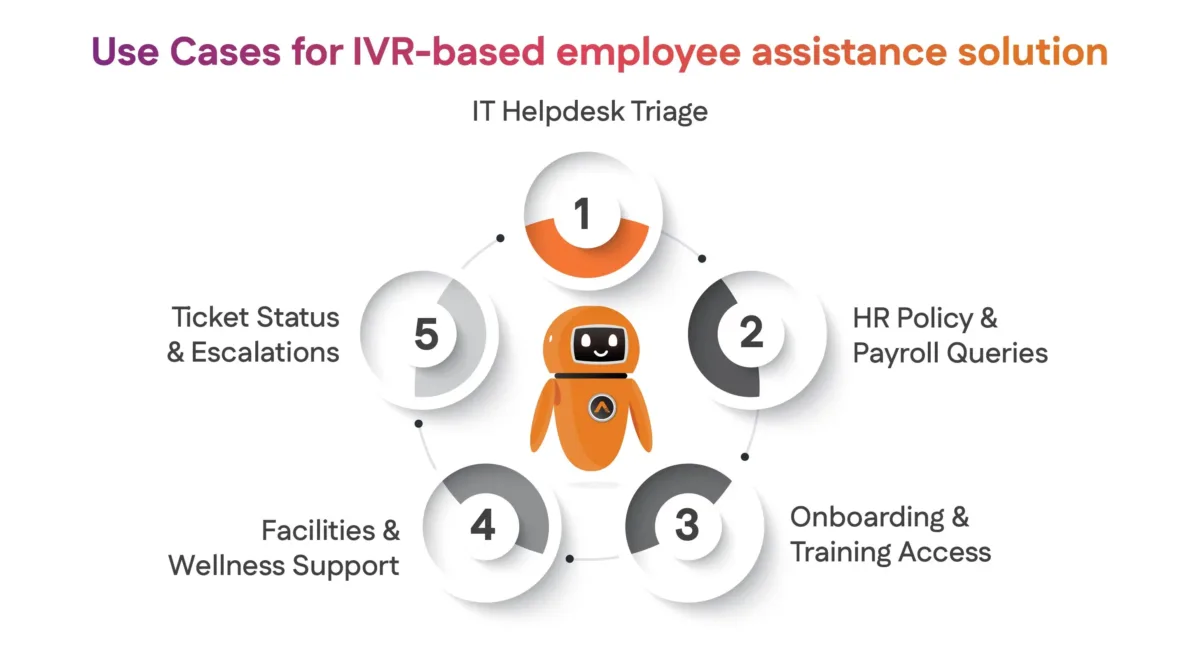
Use Cases for IVR-based employee assistance solution
IVR-based employee assistance solutions deliver conversational IVR for 24/7 employee support automation, deflecting routine queries via voice bots for employee support. Below are key use cases tailored for technical teams, especially in BFSI.
-
IT Helpdesk Triage
Employees call for VPN issues, software installs, or hardware faults. The AI-powered IVR system uses NLP to diagnose (e.g., “Run network test”), auto-resolves 40% of cases via API integrations with ServiceNow/Intune, and escalates with context—cutting AHT by 85%.
-
HR Policy & Payroll Queries
Staff asks “What’s my leave balance?” or “Payslip status?”. Conversational AI IVR authenticates via voice biometrics, pulls from HRIS (e.g., Workday), and emails documents. Deflects 60% of tier-1 HR tickets, ensuring compliance with labor laws.
-
HR Policy & Payroll Queries
Staff asks “What’s my leave balance?” or “Payslip status?”. Conversational AI IVR authenticates via voice biometrics, pulls from HRIS (e.g., Workday), and emails documents. Deflects 60% of tier-1 HR tickets, ensuring compliance with labor laws.
-
Onboarding & Training Access
New hires request “Laptop setup guide” or “Compliance training link”. The AI in IVR automation provisions MDM profiles, sends personalized checklists, and schedules sessions—boosting onboarding completion by 25% for remote/global teams.
-
Facilities & Wellness Support
With queries like “Book meeting room” or “Mental health resources”, IVR integrates with calendars (Outlook) and EAP portals, handles multilingual requests, and runs pulse surveys—improving employee NPS by 15-20%.
-
Ticket Status & Escalations
“Update on ticket #EMP-123?” triggers real-time SLA checks from ITSM tools. Bot provides ETAs, notes, and self-help links; complex cases hand off seamlessly—achieving 50% deflection and 80% faster agent ramp-up.
- HR Onboarding and Queries: Voice bots schedule interviews, answer policy questions, and track onboarding tasks, boosting completion rates by 10-20%.
- IT Support: Employees request VPN troubleshooting, device setups, or ticket status updates; the AI triages and resolves 30-50% of tier-1 issues automatically.
- Pulse Surveys and Wellness: Conducts quick eNPS checks or routes to mental health resources via natural voice, lifting response rates by 20-35%.
- Facilities Management: Handles room bookings, parking status, or ergonomic requests, supporting non-desk and multilingual staff inclusively.
- Learning and Performance: Recommends courses, sends deadlines, or captures feedback, standardizing responses to cut errors.
These applications make employee support automation scalable across shifts and time zones.
Integrate Gen AI and AI with Conversational IVR
Integrating GenAI and automation with conversational IVR supercharges employee support automation by enabling AI-powered IVR systems to process complex queries via natural language, personalize responses from enterprise knowledge bases, and execute workflows seamlessly.

Key Benefits of Conversational IVR
Conversational IVR cuts costs by automating repetitive tasks, reducing support staff needs while maintaining service quality. It ensures 24/7 availability, faster resolutions through NLP, and consistent protocols, minimizing wait times and errors. Additional gains include smooth escalations with context handoff to agents, higher query deflection rates (30-50%), and real-time insights for better decisions.
| Benefit | Impact on Employee Support | Metric Example |
|---|---|---|
| Cost Reduction | Fewer live agents for routine queries | 30-50% deflection of tier-1 HR/IT tickets |
| Speed | Seconds vs. hours for resolutions | 10-20% faster onboarding |
| Availability | 24/7 coverage across time zones | Supports shift workers and holidays |
| Accuracy | Standardized, context-aware responses | Reduced policy misinterpretation |
| Scalability | Handles multiple calls simultaneously | No congestion during peaks |
How Conversational AI IVR Differs from Legacy IVR Systems
Legacy IVR systems rely on rigid, menu-driven prompts—like “Press 1 for HR, 2 for IT”—forcing users through frustrating touch-tone mazes that often lead to dead ends or long hold times. In contrast, conversational AI IVR uses advanced natural language processing (NLP), speech recognition, and machine learning to understand natural speech, such as “Help me with my VPN login.” This AI in IVR automation maintains context across dialogues, personalizes responses by pulling from CRM data, and seamlessly escalates to live agents with full conversation history.
| Feature | Legacy IVR | Conversational AI IVR |
|---|---|---|
| Interaction Style | Rigid menus (“Press 1 for HR”) with keypresses or limited voice commands | Natural speech (“Help with VPN login”) via NLP and speech recognition |
| Intelligence | Rule-based scripts, no learning or context | ML-driven intent recognition, adaptive learning, multi-turn context |
| Resolution Rate | 20-30% self-service, high drop-offs (70%) | 80-90% auto-resolution for tier-1 queries |
| Integration | Basic CTI, limited APIs | Deep CRM/ServiceNow/AD APIs for personalization |
| Scalability | Call limits, costly reprogramming | Unlimited cloud scaling, self-improving |
| Analytics | Basic menu stats | Intent/emotion analysis, rich insights |
| Employee Support Impact | Long holds (8-12 min AHT) | 91% faster (45 sec), 50% deflection |
Key differences include:
- Interaction Style: Rigid keypresses vs. free-form voice conversations.
- Intelligence: Rule-based scripts vs. intent recognition and adaptive learning.
- Efficiency: High drop-off rates (up to 70%) vs. 80-90% self-service resolution.
- Scalability: Limited concurrent calls vs. unlimited handling with cloud-based AI-powered IVR systems.
This shift makes employee support automation truly intuitive and effective.
Role of Conversational IVR in BFSI
In BFSI, conversational IVR automates employee support for compliance checks, transaction verifications, and regulatory updates, streamlining internal operations. Voice bots assist staff with account summaries, fraud alerts, or product info, freeing agents for high-value tasks amid strict regulations. For Indian BFSI firms, AI in IVR automation integrates with CRM for real-time query handling, enhancing efficiency in high-volume environments like banks and insurers.
IT Service Desk Automation for Queries via Voice Bot for Employee Support
Suppose, in a mid-sized BFSI firm managing 5,000+ employees across branches, the IT service desk faces 40% of tickets related to compliance verifications, password resets for core banking systems, and regulatory policy lookups under RBI guidelines. Peak-hour call volumes spikes 3x during month-end reconciliations, overwhelming legacy IVR and leading to 25-minute average hold times and 35% ticket backlog.
Deploy an AI-powered IVR system integrated with AutomationEdge’s platform, leveraging conversational AI IVR with NLP engines (e.g., Google Dialogflow CX or custom Rasa models) and speech-to-text via Azure Cognitive Services. The voice bot for employee support now connects to Active Directory for authentication, pulls real-time data from ServiceNow ITSM, and queries internal compliance databases via secure APIs.
This employee support automation via conversational IVR not only scales for 24/7 operations across time zones but ensures audit-ready responses, minimizing regulatory fines under DPDP Act 2023.
Futuristic Approach
Conversational AI IVR will feature enhanced speech recognition for accents and noise, contextual understanding of emotions, and omnichannel integration with messaging apps. Machine learning advances enable proactive engagement, real-time analytics, and robust data security for sensitive employee data. Expect agentic AI to predict needs, like pre-fetching HR docs, transforming voice bots for employee support into intuitive digital colleagues.