
What is Audit Automation ?
Audit automation in banking refers to the use of AI, robotic process automation (RPA), analytics tools, and software to automate compliance checks, transaction monitoring, risk assessments, and audit reporting with intelligent workflows. It helps banks reduce manual errors, improve regulatory compliance, detect fraud faster, and streamline internal audit workflows.
Automated auditing in financial services leverages technologies like RPA, machine learning, and agentic AI to handle repetitive tasks such as data extraction, anomaly detection, and report generation.
The market is booming—global audit automation spending in BFSI hit $5.2 billion in 2025, projected to reach $12.8 billion by 2030 (per Gartner). Banks face mounting regulatory pressures from Basel IV and DORA, driving 70% of institutions to adopt risk and audit automation tools. AutomationEdge leads with audit automation solutions for banks, including banking audit management software like audit bots for banking that integrate seamlessly into core systems.
Why Audit Automation is Important ?
Manual audits in banks struggle with escalating volumes—over 40% of audit teams report backlogs due to manual audit challenges in banks like error-prone data handling and delayed insights. Automated compliance audits address this by enabling continuous monitoring and auditing in banking, ensuring real-time compliance.
In a sector where non-compliance fines exceeded $10 billion last year, compliance automation in banking via automation cuts risks by 60%, boosts efficiency, and frees auditors for strategic work. Internal AI-powered audit management is no longer optional; it’s essential for agility in digital transformation.
AI-Powered Audits vs Traditional Banking Audits
Traditional banking audits rely heavily on manual sampling, spreadsheet reviews, and periodic compliance checks. AI-powered audit automation enables continuous monitoring, real-time risk detection, and faster audit reporting through intelligent automation.
| Traditional Audits | AI-Powered Audit Automation |
|---|---|
| Manual data collection | Automated data extraction |
| Periodic reviews | Continuous monitoring |
| Higher human error risk | AI-based anomaly detection |
| Slower reporting cycles | Real-time audit dashboards |
| Reactive compliance approach | Predictive risk management |
| Resource-intensive workflows | Scalable automated processes |
AI does not replace auditors entirely. Instead, it enhances audit efficiency by automating repetitive tasks while allowing audit teams to focus on strategic analysis, governance, and decision-making.
What Are the Types of Audit Automation
Audit automation spans several types tailored to banking needs:
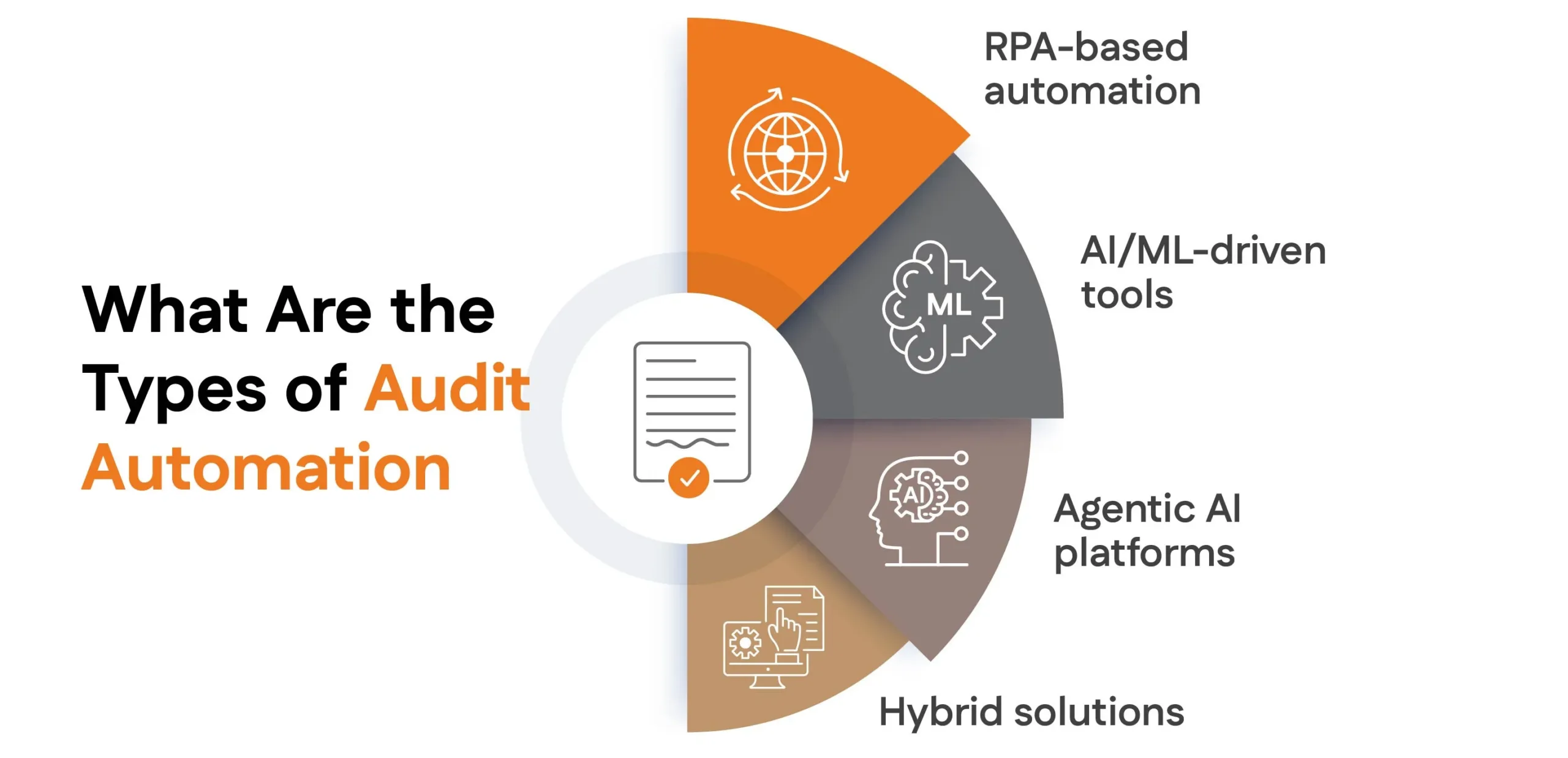
- RPA-based automation: Handles rule-based tasks like data entry and reconciliation.
- AI/ML-driven tools: Powers predictive analytics for fraud detection and anomaly spotting.
- Agentic AI platforms: Autonomous agents manage end-to-end automated audit workflows in banking, from planning to reporting.
- Hybrid solutions: Combine bots with human oversight, like AutomationEdge’s audit bot for banking.
These types support risk and audit automation tools, scaling from basic scripting to full continuous monitoring and auditing in banking.
Role of AI Agents in Banking Audits
AI agents in banking audits act like intelligent digital auditors that continuously monitor transactions, identify compliance risks, validate records, and generate audit insights automatically. Unlike traditional automation, agentic AI can analyze patterns, make contextual decisions, and trigger corrective actions in real time.
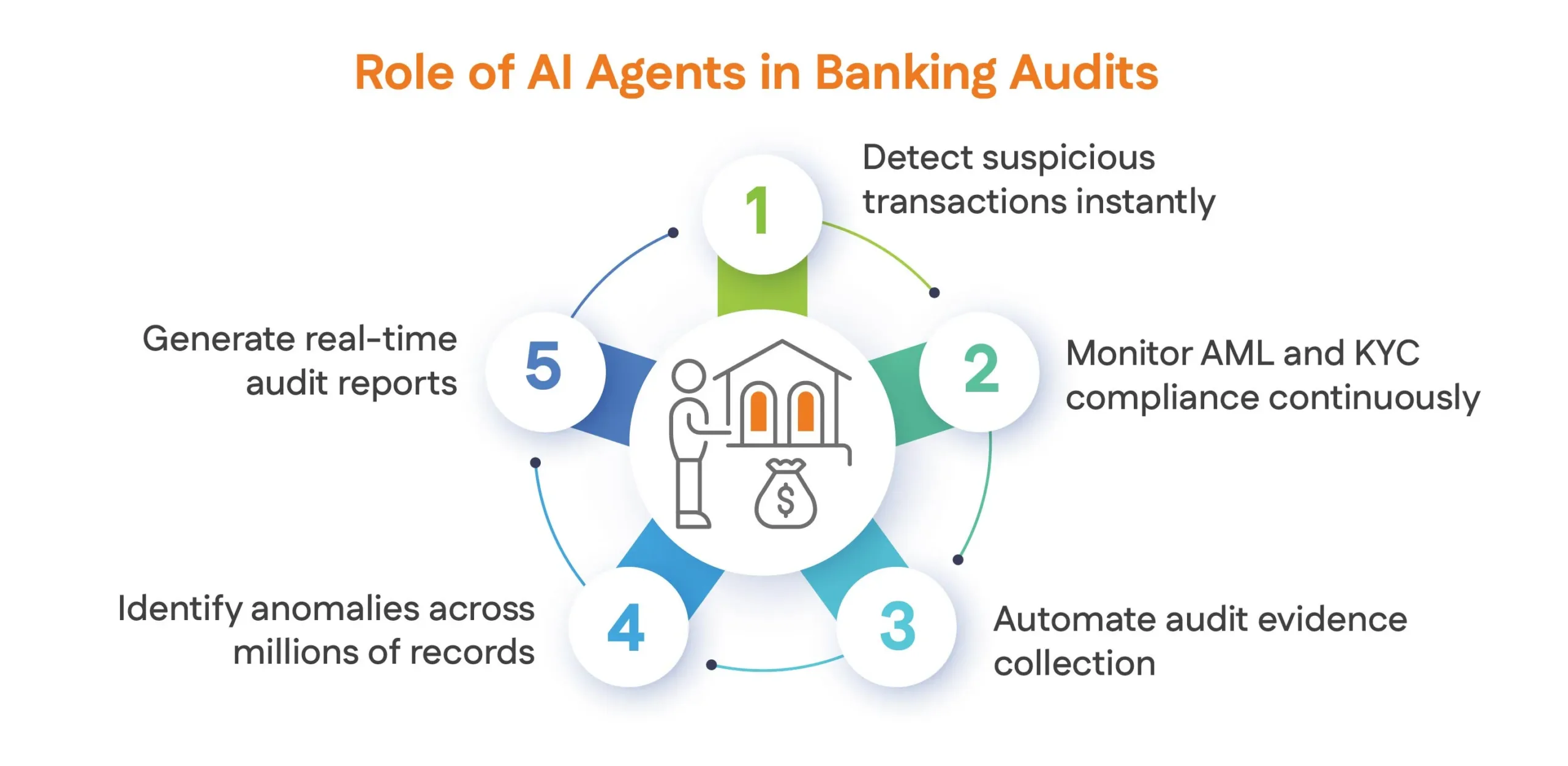
Banks use AI agents to:
- Detect suspicious transactions instantly
- Monitor AML and KYC compliance continuously
- Automate audit evidence collection
- Identify anomalies across millions of records
- Generate real-time audit reports
AI-powered audit agents help banks reduce manual workload, improve compliance accuracy, and accelerate audit cycles while strengthening risk management.
Benefits of Automated Audits
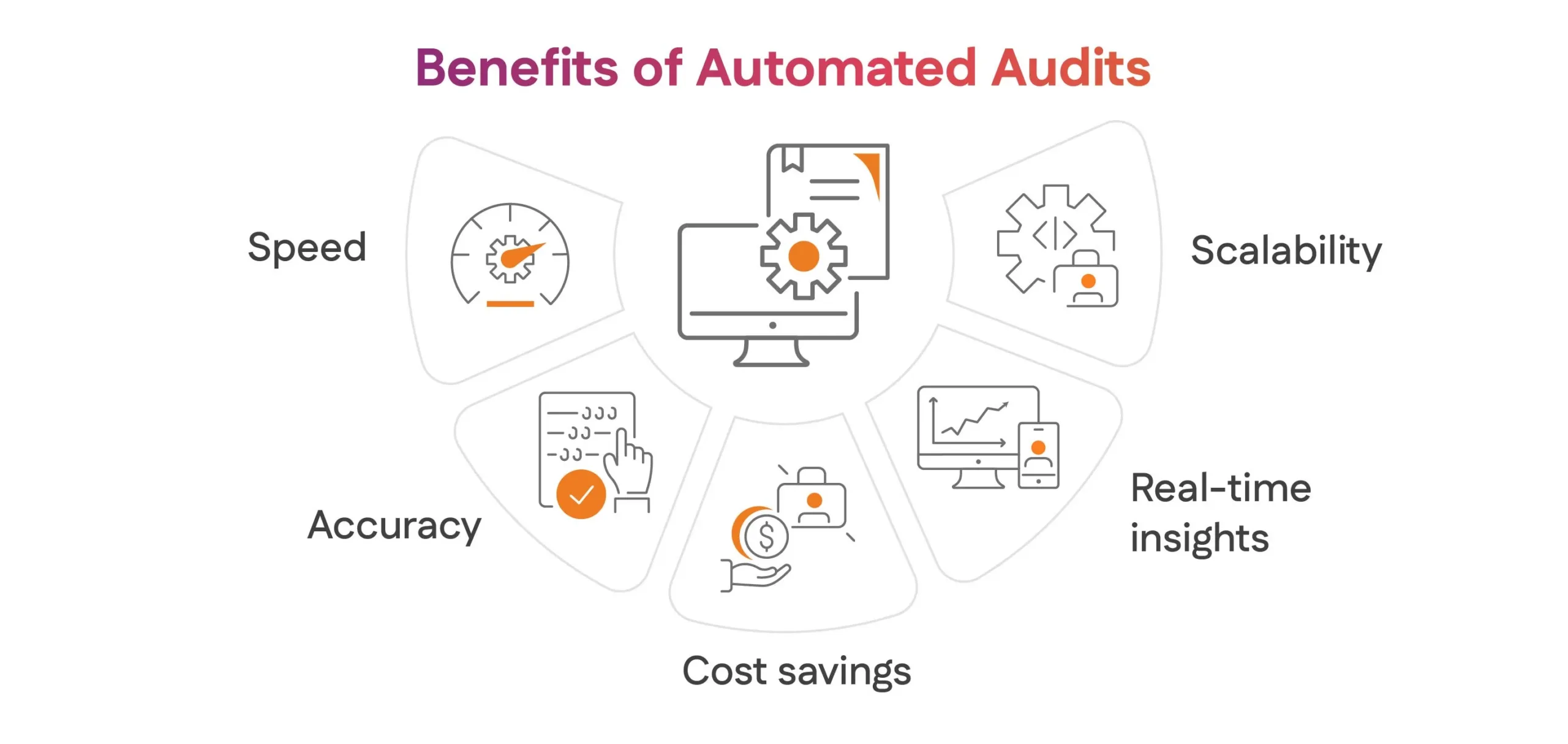
- Speed: Processes that took weeks now finish in hours, reducing audit backlog in banks.
- Accuracy: AI eliminates 95% of human errors in data validation.
- Cost savings: Up to 50% reduction in audit expenses through automation.
- Real-time insights: Real-time audit dashboards provide instant visibility into risks.
- Scalability: Handles growing transaction volumes without proportional staff increases.
Banks using internal automated banking audits report 30% higher compliance rates and faster regulatory responses.
ROI of Audit Automation in Banking
Audit automation delivers measurable ROI by reducing manual effort, accelerating compliance processes, and improving risk visibility across banking operations.
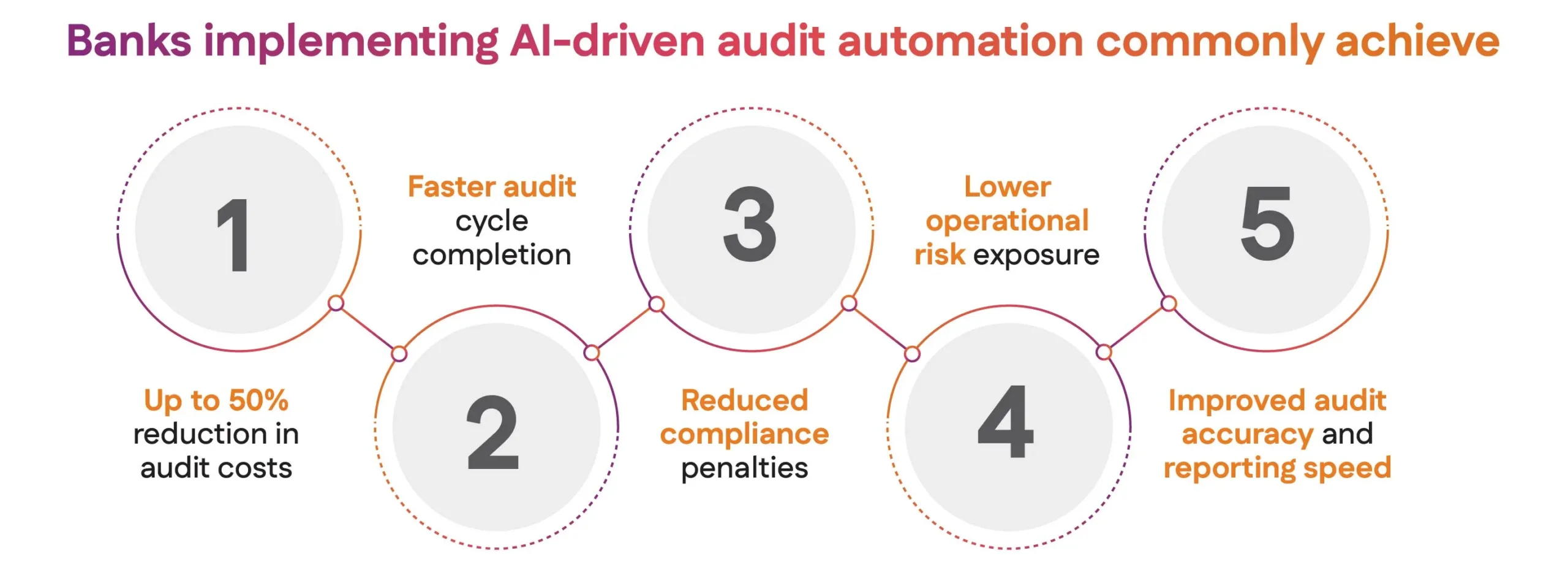
Banks implementing AI-driven audit automation commonly achieve:
- Up to 50% reduction in audit costs
- Faster audit cycle completion
- Reduced compliance penalties
- Lower operational risk exposure
- Improved audit accuracy and reporting speed
By automating repetitive tasks such as transaction validation, control testing, and report generation, banks can shift audit teams toward strategic risk analysis and governance activities.
Real-time audit dashboards and continuous monitoring also help institutions identify issues earlier, preventing fraud losses and regulatory violations.
Example ROI Metrics:
- 70% faster audit planning
- 80% reduction in documentation time
- 24/7 transaction monitoring
- 60% reduction in compliance risks
Use Cases of AI in Banking Audits
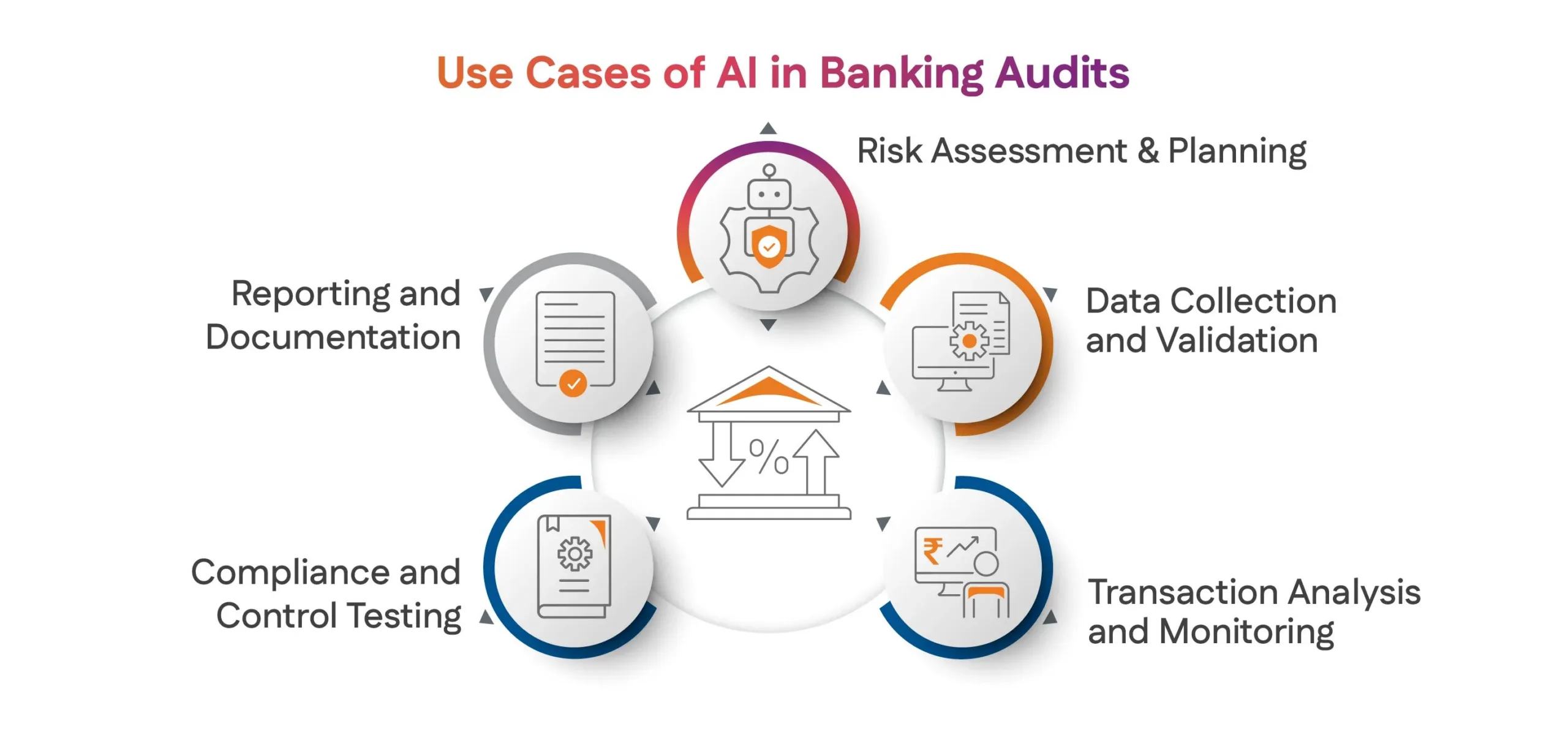
Use cases of banking audit automation shine in core processes. Here’s how automation helps:
-
Risk Assessment and Planning
Risk and audit automation tools analyze historical data and market trends to prioritize high-risk areas. AutomationEdge’s agents score risks in real-time, cutting planning time by 70% versus manual reviews.
-
Data Collection and Validation
Automation pulls data from disparate sources like core banking systems, validating accuracy instantly. This tackles manual audit challenges in banks, ensuring clean datasets for analysis.
-
Transaction Analysis and Monitoring
Continuous monitoring and auditing in banking flags anomalies in millions of transactions using AI pattern recognition. Automation helps by alerting on suspicious patterns 24/7, preventing fraud losses.
-
Compliance and Control Testing
Compliance automation in banking automates checks against regulations like KYC/AML. Tools simulate tests across controls, generating evidence trails automatically.
-
Reporting and Documentation
Automated audit workflow in banking compiles findings into compliant reports with real-time audit dashboards. Automation streamlines this, reducing documentation time by 80%.
Banks have different target applications in which customer records are maintained. The audit solution provides required forms and application and ability to connect to different target systems to provide required documents to audit team quickly.
This system is useful not only to auditors but also to bank staff located in different branches and central operations. The different target systems that can be covered include loan management system, core banking system, bank’s internal and third-party applications.
How Audit Automation Improves AML & KYC Compliance
Internal audit automation helps banks streamline AML (Anti-Money Laundering) and KYC (Know Your Customer) compliance through continuous monitoring, automated verification, and real-time risk detection.
AI-powered audit systems can:
- Automatically validate customer records
- Monitor suspicious transaction patterns
- Detect compliance gaps in real time
- Generate audit-ready regulatory reports
- Reduce false positives using machine learning
Instead of relying on manual reviews, banks can use intelligent compliance automation to strengthen fraud prevention, improve regulatory readiness, and accelerate investigation workflows.
Automated AML and KYC audits also help banks comply with evolving regulations while reducing operational costs and audit delays.
How Audit Automation Improves AML & KYC Compliance
It follows an intelligent cycle: AI agents ingest data via APIs, apply rules/ML models for analysis, flag issues on dashboards, and auto-generate reports. Banking audit management software like AutomationEdge orchestrates this—bots crawl transaction logs, validate against policies, and escalate exceptions.
Integration with existing ERPs ensures seamless internal audit automation, with human auditors intervening only for judgment calls.
How to Implement Audit Automation
Implementing audit automation in banking involves these steps:
- Assess needs: Map current manual audit challenges in banks and prioritize use cases.
- Select tools: Choose scalable risk and audit automation tools like audit automation solution for banks.
- Pilot phase: Test on one department, integrating with core systems.
- Scale and train: Roll out with user training and monitoring.
- Optimize: Use analytics to refine workflows.
Start small—many banks see ROI in 6 months.
Best Practices for Implementing Audit Automation in Banking
Successful audit automation in banking requires the right mix of AI, process standardization, and human oversight. Following these best practices helps banks improve compliance, reduce risks, and maximize automation ROI.
-
Start with High-Volume Audit Tasks
Begin automation with repetitive and time-consuming tasks such as:
- transaction monitoring
- compliance checks
- data validation
- report generation
This delivers faster ROI and reduces audit backlogs quickly. -
Integrate with Core Banking Systems
Choose audit automation solutions that integrate seamlessly with:
- core banking platforms
- ERP systems
- AML/KYC tools
- document management systems
API-based integration ensures real-time data access and continuous audit monitoring. -
Use AI for Risk-Based Auditing
AI-powered audit tools help identify anomalies, detect fraud patterns, and prioritize high-risk transactions for faster and more accurate audits.
-
Maintain Human Oversight
While AI automates repetitive audit tasks, human auditors remain essential for:
- decision-making
- regulatory interpretation
- investigation handling
- governance reviews
The most effective approach combines automation with expert supervision. -
Enable Real-Time Audit Dashboards
Real-time dashboards provide instant visibility into:
- compliance gaps
- suspicious transactions
- operational risks
- audit status tracking
This supports faster decision-making and proactive risk management. -
Standardize Audit Workflows
Define clear audit workflows, approval rules, escalation paths, and compliance policies before automation deployment. Standardized processes improve consistency and reduce operational risk.
-
Monitor and Optimize Continuously
Regularly update workflows, dashboards, and compliance rules to adapt to changing banking regulations and operational risks.
Challenges and Solutions in Audit Automation
Deploying conversational and agentic AI across financial channels delivers measurable returns across the board:
- System Integration and Compatibility
Challenge: Legacy banking systems resist modern tools, causing data silos.
Solution: Opt for API-first platforms like AutomationEdge’s audit bot for banking, which supports 100+ connectors for smooth automated audit workflow banking.
- Implementation and Onboarding
Challenge: Complex setups lead to delays and audit backlog in banks.
Solution: Phased rollouts with vendor support ensure quick wins, often under 90 days.
- Change Management and Adoption
Challenge: Auditors resist shifting from manual processes.
Solution: Training programs and real-time audit dashboards demonstrate value, boosting buy-in.
- Maintenance and Scalability
Challenge: Evolving regulations demand constant updates.
Solution: Cloud-native banking audit management software auto-scales and patches, minimizing downtime.
Future of Audit Automation in Banking
Future of audit automation in banking points to full AI autonomy.
Can AI replace manual audits in banking?
Not entirely—AI will handle 80% of routine tasks by 2030, as per Deloitte, with humans focusing on strategy.
Expect hyper-personalized continuous monitoring and auditing banking via multi-agent systems, predictive compliance, and blockchain integration. How to improve compliance audits in banks? Embrace audit automation solution for banks now for a resilient edge.