
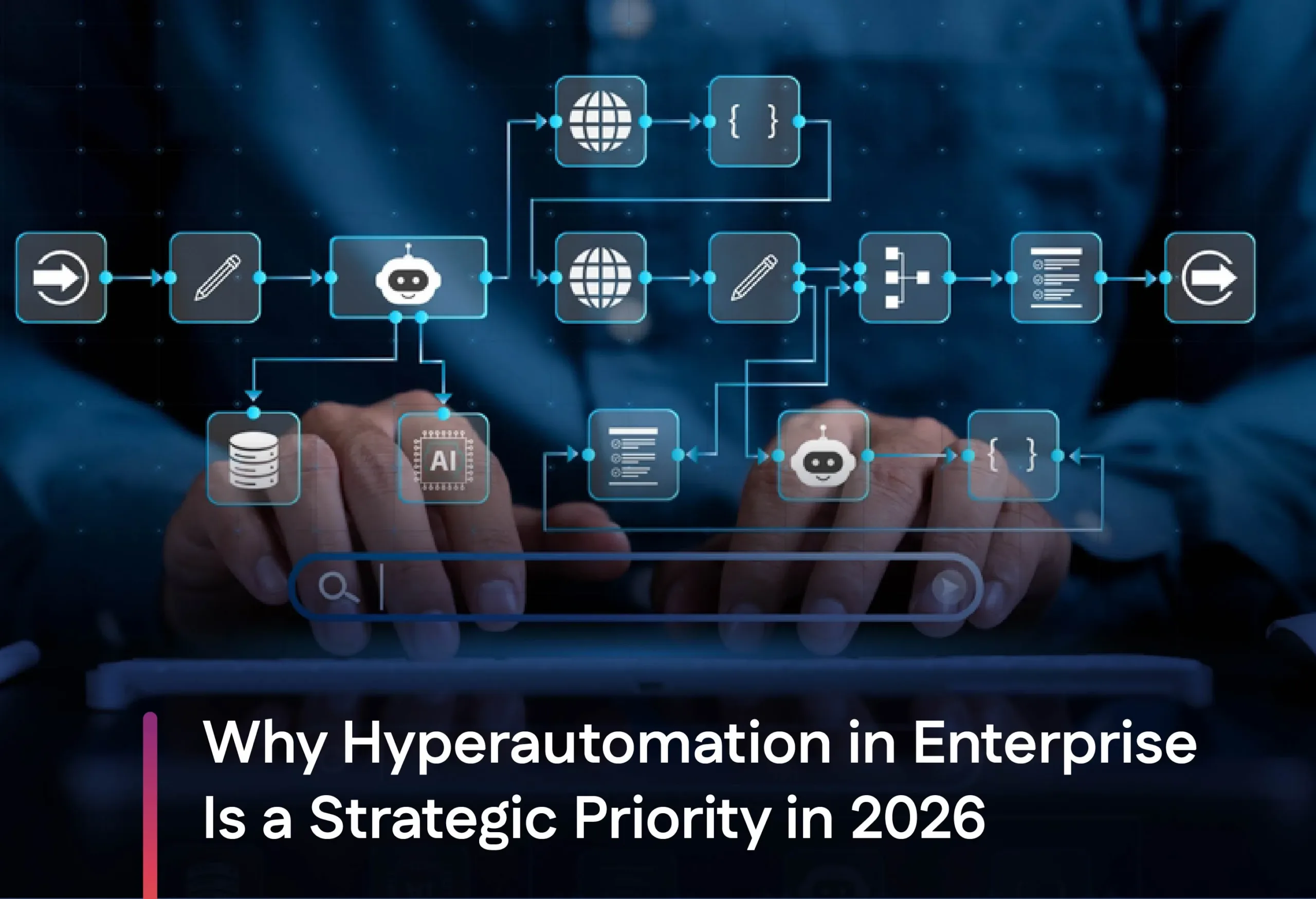
Hyperautomation examples are shaping how modern businesses operate in 2026. As hyperautomation in enterprise environments accelerates, organizations are combining AI, RPA, machine learning, and process intelligence to automate complex, end-to-end workflows. These hyperautomation applications go beyond basic task automation, enabling smarter decisions, faster execution, and scalable operations across departments.
From finance and HR to IT and customer experience, AI and hyperautomation are redefining efficiency and resilience. Hyperautomation Market size was USD 58.4 billion in 2025 and is estimated to reach USD 278.3 billion by the end of 2035, expanding at a CAGR of 16.9% during the forecast period.
In this blog, we will discuss how hyperautomation examples are transforming enterprise operations by combining AI, RPA, and intelligent automation. We explore real-world hyperautomation use cases across banking, insurance, IT, and finance, highlighting how enterprises improve speed, accuracy, compliance, and customer experience. The blog also covers future hyperautomation trends, common mistakes leaders must avoid, and how platforms like AutomationEdge enable scalable, secure, and enterprise-ready automation.
What is Hyperautomation?
Hyperautomation is an advanced approach to automation that combines AI, machine learning (ML), robotic process automation (RPA), process mining, and analytics to automate and optimize business processes end to end. The term was popularized by Gartner, which predicts that enterprises can reduce operational costs by adopting hyperautomation technologies.
In simple terms, hyperautomation goes beyond basic task automation. It connects multiple technologies to automate not just repetitive, rule-based work, but also complex, decision-driven processes that once required human judgment. This enables faster execution, better accuracy, and continuous process improvement across the enterprise.
Example:
- In finance, hyperautomation can automatically process invoices—capturing data, validating it using AI, detecting fraud patterns, and triggering payments without manual intervention.
- In customer support, AI and hyperautomation can analyze incoming queries, route them intelligently, resolve common issues via bots, and escalate only complex cases to human agents.
Top Hyperautomation Use Cases to Look for in 2026

-
Customer Service
Hyperautomation transforms customer service by combining AI chatbots, RPA, and analytics to handle queries end to end. It automates ticket creation, categorization, routing, and resolution using data-driven insights. AI analyzes customer behavior to personalize responses and improve satisfaction. Complex issues are routed to the right agent automatically.
Example: An AI bot resolves common issues instantly and assigns billing disputes to a finance expert.
-
Claims Processing
Hyperautomation uses OCR, NLP, and ML to extract claims data from documents and emails. It validates data against policy systems, checks coverage, and flags anomalies. RPA then processes approved claims and updates customers automatically. Fraud detection models run in real time to reduce risk.
Example: Insurance claims are approved and paid without manual review.
-
Anti-Money Laundering (AML)
Hyperautomation automates AML compliance by integrating AI, RPA, and data analytics. It collects customer data, screens it against regulatory databases, and monitors transactions continuously. ML models detect suspicious patterns and trigger alerts for investigation. This reduces compliance risk and manual workload.
Example: High-risk transactions are flagged instantly during real-time monitoring.
-
Underwriting
Hyperautomation accelerates underwriting by automating data collection from multiple sources. AI and ML assess risk using structured and unstructured data, while RPA handles approvals and documentation. The system continuously learns from past decisions to improve accuracy. Compliance checks are embedded throughout the process.
Example: Loan risk is evaluated using credit data and social signals in minutes.
Fast-track your understanding of automated insurance underwriting — infographic inside!
Download Visual Guide -
Customer Onboarding
Hyperautomation simplifies onboarding by automating KYC, document verification, and risk scoring. AI extracts data from IDs and forms, while RPA updates backend systems. Human-in-the-loop models validate exceptions to ensure accuracy. This reduces onboarding time and improves customer experience.
Example: A bank account is opened digitally within minutes.
-
Accounts Payable
Hyperautomation streamlines accounts payable by automating invoice capture, validation, and approvals. AI-powered OCR extracts invoice data, while RPA matches it with purchase orders. ML detects duplicate or fraudulent invoices and optimizes payment timing. ERP integration ensures compliance and audit readiness.
Example: Vendor invoices are processed and paid automatically.
-
IT Infrastructure Management
Hyperautomation automates IT operations like provisioning, monitoring, and incident management. AI predicts failures, while RPA executes corrective actions. Self-healing systems reduce downtime and manual intervention. This enables proactive IT management and better system performance.
Example: Servers auto-scale during peak demand without human input.
While use cases show how hyperautomation works in practice, understanding its broader impact is essential. Learn how hyperautomation is reshaping the IT industry and accelerating digital transformation.
Discover Hyperautomation in IT→ -
KYC and Fraud Detection
Hyperautomation enhances KYC and fraud detection using AI, ML, and intelligent automation. It automates data entry, verifies identities, and analyzes transactions for suspicious behavior. Advanced models predict fraud risks before losses occur. Regulatory reporting is also automated.
Example: Fraudulent transactions are blocked before completion.Stop fraud before it impacts your bottom line
See the key claims fraud scenarios AI can uncover instantly.
View the Infographic -
Loan Processing
Hyperautomation speeds up loan processing by automating data extraction, verification, and risk assessment. AI chatbots assist applicants, while ML models evaluate creditworthiness. RPA manages approvals, compliance checks, and documentation. This leads to faster decisions and better customer experience.
Example: Personal loans are approved within hours instead of days.
-
Policy Administration & Financial Reporting
Hyperautomation automates policy and financial data collection from multiple systems. AI validates and cleanses data, while bots generate real-time reports. Built-in compliance checks and audit trails ensure transparency. This reduces errors and supports smarter decision-making.
Example: Financial reports are generated automatically at month-end.
Why Enterprises Must Adopt AI-Powered Hyperautomation
AI-powered hyperautomation brings together AI, RPA, and intelligent automation to modernize enterprise operations. It helps organizations move faster, reduce costs, and deliver smarter customer experiences across industries like banking, insurance, and finance.
Here’s why enterprises are rapidly adopting hyperautomation:
- Faster Process Execution: Automates both repetitive and complex workflows, cutting processing time.
- Lower Operational Costs: Reduces manual effort, rework, and errors through streamlined, automated workflows.
- Stronger Compliance: Built-in audit trails, AML checks, and automated reporting ensure regulatory adherence.
- Higher Accuracy: AI and ML validate data, minimizing errors in onboarding, claims, and loan processing.
- Personalized Customer Experiences: Intelligent bots analyze customer data to deliver tailored interactions.
- Real-Time Fraud Prevention: ML models detect anomalies instantly, reducing financial and operational risks.
- Enterprise Scalability: Cloud-based hyperautomation enables rapid scaling and faster adaptation to change.
AutomationEdge enables enterprises to achieve hyperautomation by combining AI, RPA, and intelligent orchestration on a single platform. It helps automate end-to-end processes, improve compliance, and scale operations efficiently.
Leadership Tip: Focus on intelligent, scalable automation that balances speed, accuracy, and compliance for lasting enterprise impact.
What Are the Future Hyperautomation Trends?
- Predictive Analytics for Personalized Services: AI predicts customer needs, offering tailored financial advice and insurance policies.
- AI-Driven Risk Management & Compliance: Real-time monitoring and anomaly detection enhance fraud prevention and regulatory adherence.
- Integration with Blockchain & IoT: Automated processes with secure, transparent data exchange for faster, smarter decision-making.
- Cloud-Based & SaaS Hyperautomation: Scalable, agile automation solutions that reduce infrastructure costs and increase speed.
- Hyper-Personalization Across Customer Touchpoints: AI bots customize experiences across onboarding, claims, and support channels.
Why AutomationEdge Is Your Hyperautomation Partner
Hyperautomation is reshaping banking and insurance operations, but real impact comes from choosing a platform that combines technology, intelligence, and enterprise readiness. AutomationEdge delivers AI-powered hyperautomation that simplifies complex workflows, improves accuracy, and elevates customer experiences while staying compliant with evolving regulations.
- End-to-End Intelligent Automation: Unifies AI, ML, and RPA to automate critical processes such as customer onboarding, underwriting, claims, and loan processing at scale.
- Enterprise-Ready Integrations: Seamlessly connects with legacy systems, ERPs, CRMs, and cloud platforms to create a single, unified automation ecosystem.
- Built-In Compliance & Insights: AI-driven analytics enable real-time visibility, predictive decision-making, and compliance with KYC, AML, and regulatory mandates.
- Human-in-the-Loop Control: Intelligent bots handle routine tasks, while human validation ensures precision in high-risk or exception-based scenarios.
- Continuous Learning & Optimization: Machine learning models evolve with every interaction, improving efficiency, reducing costs, and enabling hyper-personalized services.
Result: Faster processes, lower risk, smarter decisions and a future-ready enterprise powered by AutomationEdge.
Common Mistakes Leaders Make While Hyperautomation
While hyperautomation delivers significant value, many initiatives fail to achieve expected outcomes due to strategic and execution gaps. Leaders often focus on tools over outcomes, underestimate change management, or overlook data readiness. Understanding these common mistakes can help enterprises build scalable, compliant, and future-ready hyperautomation programs.
| Common Mistake | Why It Happens | Business Impact | How to Avoid It |
|---|---|---|---|
| Automating Broken Processes | Focus on speed instead of process optimization | Inefficiencies scale faster, increasing errors | Redesign and standardize processes before automation |
| Treating Hyperautomation as RPA Only | Limited understanding of AI and ML capabilities | Missed opportunities for intelligence and decision-making | Combine RPA with AI, ML, process mining, and analytics |
| Ignoring Data Quality & Readiness | Poor data governance and silos | Inaccurate outputs and unreliable automation | Clean, standardize, and govern data early |
| Lack of Clear Business Objectives | Automation driven by IT, not business goals | Low ROI and stakeholder dissatisfaction | Define measurable KPIs tied to business outcomes |
| Overlooking Compliance Early | Compliance added after automation rollout | Regulatory risk and rework | Embed KYC, AML, and audit trails from day one |
| No Human-in-the-Loop Strategy | Over-reliance on full automation | Errors in high-risk or exception scenarios | Enable human validation for critical decisions |
| Poor Change Management | Employees not trained or aligned | Low adoption and resistance to automation | Invest in training and communication |
| Scaling Too Fast, Too Soon | Pilots skipped or rushed | System instability and failures | Start small, validate, then scale strategically |
Conclusion
Hyperautomation is no longer optional; it is a strategic necessity for enterprises aiming to stay competitive. By combining AI, RPA, and intelligent automation, organizations can streamline operations, reduce costs, strengthen compliance, and deliver hyper-personalized customer experiences at scale.
The future of hyperautomation in banking and insurance is set to revolutionize the way these industries operate, with a focus on delivering seamless, efficient, and personalized services. Emerging hyperautomation solutions will integrate advanced technologies such as AI, machine learning, blockchain, and IoT to automate complex processes and enhance decision-making. Tasks like loan processing, claims management, and regulatory compliance will be fully automated, reducing operational costs and human error while improving accuracy and speed.
As customer expectations evolve, hyperautomation will enable hyper-personalized services, leveraging predictive analytics to offer tailored financial advice and customized insurance policies. Moreover, real-time fraud detection and risk mitigation will become more robust with the integration of AI-driven hyperautomation solutions.
The adoption of scalable technologies like cloud computing and SaaS platforms will further accelerate this transformation, making banking and insurance more agile, transparent, and customer-centric than ever before.
Frequently Asked Questions
Real-world examples of hyperautomation include automated KYC in banking, claims processing in insurance, invoice automation in finance, and self-healing IT systems.