
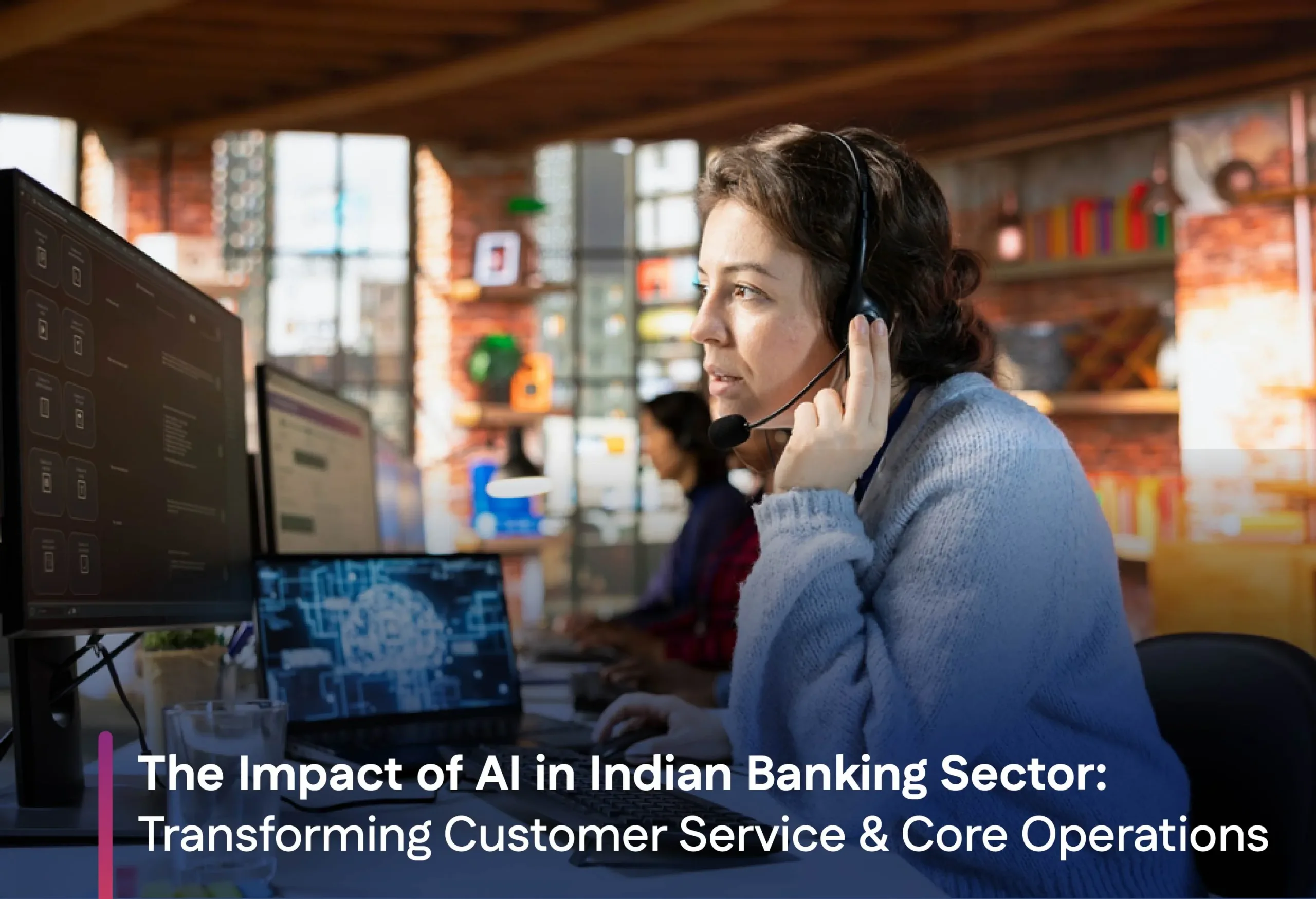
India’s banking ecosystem is one of the most digitally active in the world. With explosive growth in digital banking in India, financial institutions are handling billions of transactions monthly while balancing regulatory complexity and rising customer expectations.
From intelligent chatbots to AI-assisted underwriting, banks are moving beyond automation toward systems that generate insights, summarize documents, draft responses, and support decisions. Generative AI is becoming the intelligence layer powering next-generation banking.
In this blog, we explored how Generative AI in Indian Banking is transforming customer service, lending, compliance, and core operations in digital banking in India. We examined key use cases such as AI for loan processing India, AI for KYC automation India, AI document processing in banks, and AI-powered virtual assistants for banks, highlighting the growing impact of AI in Indian banking sector.
The Rise of AI in India’s Digital Banking Era
India’s financial ecosystem has evolved rapidly over the last decade. UPI adoption, mobile-first banking, fintech partnerships, and API-driven infrastructure have created an always-on, high-volume environment.
As digital banking in India expands, banks face three core pressures: handling massive customer volumes, maintaining compliance, and reducing operational costs. This is where AI steps in as a structural enabler.
The future of digital banking in India will depend on how effectively institutions integrate AI into daily workflows rather than treating it as a separate innovation project.
Key drivers accelerating AI adoption include:
- Explosive growth in digital transactions and UPI usage
- Rising customer expectations for instant service
- Increased competition from fintech platforms
- Cost pressures in branch and call center operations
- Regulatory expectations for traceability and auditability
Generative AI provides a way to scale intelligence alongside scale of operations.
What Generative AI Means for Indian Banks
Generative AI in finance and banking goes beyond chatbots. It acts as a cognitive assistant embedded inside workflows. Instead of just predicting outcomes, it generates contextual responses, summaries, risk explanations, and decision support insights.
In practical banking terms, this means AI can read documents, draft customer emails, summarize loan files, answer internal knowledge queries, and assist relationship managers in real time.
For banks, generative AI enables:
- Intelligent customer query resolution
- Automated email and communication drafting
- Document summarization and compliance explanation
- Knowledge retrieval across large policy repositories
- Context-aware interaction across multiple channels
This shift transforms AI from a tool into a workflow participant.
How Indian Banks Are Using Generative AI Today
-
AI-Powered Customer Support
Indian banks are deploying AI-powered virtual assistants for banks to handle millions of daily interactions. These systems provide multilingual support, addressing queries in Hindi and regional languages, reducing pressure on call centers. Instead of scripted responses, generative AI understands context and generates conversational answers. This improves resolution rates and customer satisfaction.
Common applications include:- Balance and transaction inquiries
- Card blocking and dispute resolution
- Loan eligibility guidance
- EMI schedule clarification
- Product comparison assistance
This is one of the most prominent generative ai use cases in banking India today.
-
AI for Loan Processing India
Loan processing traditionally involves document-heavy manual review. Generative AI accelerates this by extracting, summarizing, and validating applicant data in seconds. With AI for loan processing India, banks can reduce turnaround time while improving consistency.
Key use cases:- Automated income proof extraction
- Credit report summarization
- Risk assessment commentary generation
- Underwriting assistance notes
- Customer communication drafting
This improves operational speed without compromising regulatory diligence.
-
AI for KYC Automation India
KYC and compliance processes are critical yet time-consuming. Generative AI enhances document verification by interpreting structured and unstructured data from ID proofs. AI for KYC automation India enables faster onboarding while maintaining compliance standards.
Banks use AI to:- Validate PAN and Aadhaar data
- Flag inconsistencies in identity documents
- Summarize compliance checks
- Generate audit-ready documentation
- Reduce onboarding friction
This leads to quicker customer acquisition with stronger governance.
-
AI Document Processing in Banks
Operational departments manage thousands of forms, statements, and requests daily. AI document processing in banks automates extraction, classification, and summarization of these documents. Generative AI enhances Intelligent Document Processing by converting raw data into actionable insights.
Common operational applications:- Statement analysis and summary generation
- Cheque data extraction
- Account opening documentation review
- Compliance reporting assistance
- Internal case note creation
This significantly reduces manual workload and error rates.
How Does Generative AI Improve Customer Experience in Banking?
Customer expectations in India are shaped by instant service across industries. Banks must provide fast, seamless, and personalized interactions. Generative AI plays a crucial role in achieving this. Indian banks using GenAI see 40% faster query resolution and 28% higher NPS vs traditional channels (RBI).
So, how does generative ai improve customer experience in banking?
It enhances speed, availability, personalization, and contextual understanding.
Generative AI helps improve customer experience banking by:
- Delivering 24/7 conversational support
- Reducing wait times and call transfers
- Personalizing product recommendations
- Providing clear explanations of fees and policies
- Minimizing branch visits through digital resolution
The result is higher satisfaction and stronger digital trust.
Impact of Gen AI in Indian Banking Sector
The impact of GenAI in Indian banking sector extends beyond customer support. It reshapes internal operations, compliance management, and workflow efficiency. GenAI boosts banking ops productivity by up to 46% (RBI) and cuts back-office costs 30-50% (Deloitte), automating workflows like KYC and claims.
Operational improvements include:
- Reduced manual data entry
- Faster account onboarding
- Improved compliance tracking
- Lower processing errors
- Streamlined case management
AI shifts employees from repetitive tasks to higher-value advisory roles.
The Shift Toward Agentic Automation for Banks
Generative AI becomes even more powerful when combined with RPA and workflow engines. This integrated approach is known as agentic automation for banks. Agentic automation enables AI systems to reason, decide, and execute tasks across multiple systems. Instead of assisting humans, these systems orchestrate end-to-end processes autonomously.
An end-to-end banking automation platform enables:
- Loan workflows that trigger validation, approval, and communication automatically
- Compliance bots that monitor transactions in real time
- AI-driven exception handling
- Multi-step onboarding orchestration
- Cross-department coordination without manual intervention
This marks a transition from task automation to process autonomy.
Major Operational Challenges in Indian Banking
Despite the benefits, generative AI adoption presents challenges. Data governance, model accuracy, and regulatory compliance must be carefully managed.
Primary risks include:
- Data security and privacy concerns
- AI hallucination or incorrect outputs
- Integration with legacy systems
- Regulatory scrutiny and audit requirements
- Skill gaps within internal teams
Strong governance frameworks are essential for long-term success.
How AutomationEdge Can Help
AutomationEdge provides an end-to-end banking automation platform designed to help financial institutions deploy AI securely and at scale. By combining Generative AI, Intelligent Document Processing, RPA, and agentic automation, the platform enables banks to automate complex workflows while maintaining compliance.
With AutomationEdge, banks can:
- Automate banking workflows across onboarding, lending, and operations
- Deploy AI-powered virtual assistants for banks
- Accelerate AI for loan processing India
- Enable AI for KYC automation India
- Implement AI document processing in banks
- Introduce agentic automation for banks with built-in governance
AutomationEdge focuses on compliance-ready, enterprise-grade generative ai solutions for banks, ensuring scalability without compromising security.
Conclusion
Generative AI in Indian Banking is moving from experimentation to enterprise adoption. As digital transactions scale and customer expectations evolve, banks must integrate AI into the core of operations. The impact of AI in Indian banking sector will be defined not just by automation, but by intelligent orchestration.
Institutions that combine generative AI with workflow automation and governance frameworks will lead the next era of digital banking in India. The opportunity is clear. The transformation is underway. Banks that act strategically today will define the future of digital banking in India.