
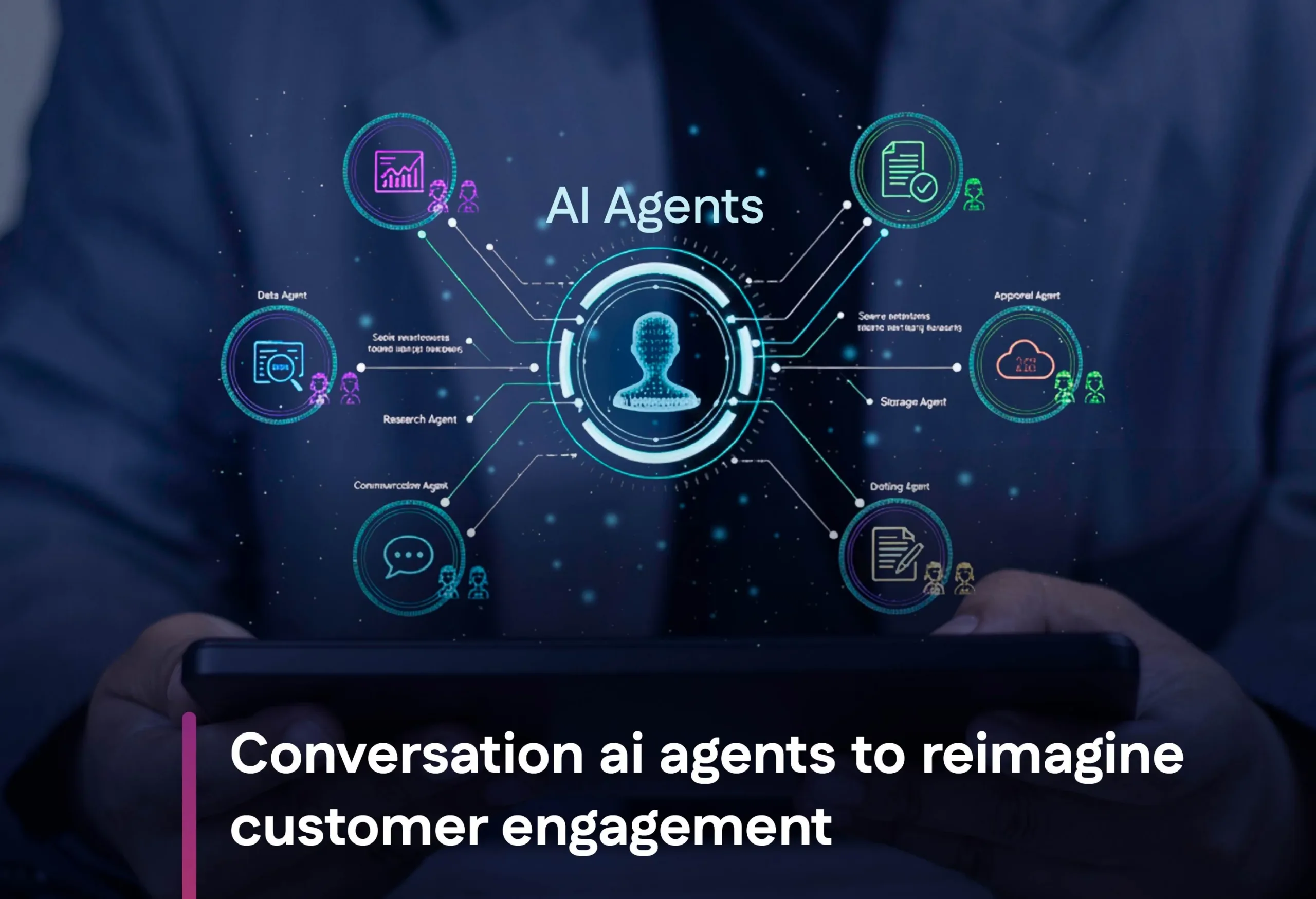
The landscape of customer interactions has shifted dramatically. The era of rigid, frustrating “if-then” chatbots that lead customers down endless dead ends is officially over. Today, forward-thinking enterprises are completely restructuring how they interact with their audience by deploying autonomous AI agents for customer service work.
This shift moves businesses away from basic, defensive automation toward a strategy of hyper-personalized, context-rich AI in customer engagement. By leveraging domain-specific AI-driven customer engagement platforms, brands are transforming support centers into powerful engines for customer loyalty and satisfaction. It is stated that 71% of consumers expect companies to deliver personalized interactions. AI agents parse behavioral data and historical purchases to recommend the “next best experience” in real-time.
What’s AI Doing in Customer Engagement?
Historically, automation in the customer journey was designed primarily for deflection—keeping the customer away from human teams to cut back-office operational costs. Today, AI in customer engagement focuses on resolution and deep contextual understanding.
Modern AI-driven customer engagement systems act as an intelligent, unified layer across your business. They do not just scan for keywords; they analyze customer intent, gauge emotional sentiment, and draw from a centralized memory base.
According to global enterprise data, over 65% of customer service organizations have actively transitioned to agentic workflows. For the first time, customer satisfaction (CSAT) has overtaken internal productivity as the number one performance indicator improved by AI.
Deliver Exceptional Conversational Experiences with Vertical AI Agents
The mass adoption of AI in customer engagement is being led by a specific architecture: vertical AI agents.
Unlike general-purpose large language models (LLMs) that know a little bit about everything, a vertical AI agent is built and fine-tuned for a specific industry, domain, or workflow (such as e-commerce, fintech, or healthcare).
| Metric / Feature | General AI Chatbots | Vertical AI Agents |
|---|---|---|
| Operational Scope | Broad, open-ended Q&A | Domain-specific task execution |
| System Integration | Surface-level API plugins | Deeply embedded into CRMs, billing, and ERPs |
| Decision Engine | Text summarization & generation | Intent analysis & multi-step planning |
| Hallucination Risk | High (requires heavy prompt guards) | Low (constrained by industry knowledge bases) |
| Pricing Model | Per-token usage costs | Pay-per-resolution outcome |
Because they are natively mapped to specific enterprise data structures, these specialized agents allow brands to deliver highly tailored, brand-consistent conversational experiences across email, chat, voice, and social channels without manual scripting.
Ways AI is Used in Customer Engagement
Implementing AI-driven customer engagement requires moving past basic static workflows. Modern organizations weave intelligence into the entire customer lifecycle through several key capabilities:

- Omnichannel Memory Sync:
Customers routinely switch between mobile apps, mails, and voice calls. AI agents maintain a single, fluid thread across all touchpoints, eliminating the need for customers to repeat their issues. - Sentiment-Aware Intelligent Routing:
If a customer exhibits frustration or presents a highly sensitive, high-stakes issue, the AI immediately flags the sentiment and routes the conversation to a senior human agent alongside a complete text summary. - Proactive Engagement Orchestration:
Instead of waiting for a friction point to occur, predictive AI analyzes real-time digital signals—such as web-form hesitation or repeated product comparison drops—and proactively offers real-time resolutions, missing order status updates, or dynamic loyalty rewards.
Use Cases for AI Agents in Customer Service
When deploying AI agents for customer service work, enterprises target high-volume, transactional interactions that traditionally bog down human support staff.
- Real-Time Transaction Dispute & Diagnostics: When a customer flags an unfamiliar fee or a declined transaction, the banking AI agent immediately accesses core ledger databases. It can check account balances, identify the precise root cause (such as an international fraud block or mismatching address rules), explain the logic to the customer, and securely process limit updates or clear temporary blocks in the same chat thread.
- End-to-End KYC and Digital Account Onboarding: Instead of manual paper processing, autonomous AI agents manage the Know Your Customer (KYC) compliance lifecycle. They ingest unstructured user document uploads (ID cards, passports, utility bills), extract structured data via optical character recognition, run instant Anti-Money Laundering (AML) background checks, and automatically ping the customer if a document is blurry or expired to prevent a backlog.
- Automated Loan Origination Assistance: AI agents speed up lending by aggregating customer financial data, income records, and credit history across separate bank systems. The agent evaluates the data against credit underwriting criteria, automatically pre-approves basic loan or credit line requests, and routes complex edge cases to human loan officers with a pre-written structural context summary.
For insurance companies, AI in customer engagement streamlines high-friction milestones—such as filing insurance claims, updating policy details, and handling unexpected volume spikes.
- Automated First Notice of Loss (FNOL) Intake: During auto or property claims filing, AI voice and digital agents handle the initial claim intake entirely. The agent collects critical incident data through natural back-and-forth conversation, guides the policyholder to upload accident photos or police reports, validates active coverage levels, and pushes a structured package directly into the core claims framework in minutes.
- Instant Policy Servicing & Mid-Term Adjustments: Routine administrative tasks—like adding a new vehicle to an active auto policy, updating a physical address, or modifying a premium beneficiary—are fully handled by authenticated AI agents. The agent reviews the existing contract rules, calculates premium adjustments, and processes the endorsement securely without requiring a live human agent.
- Catastrophe (CAT) Emergency Volume Management: During massive environmental disruptions (like hurricanes, floods, or wildfires), inbound claim volumes instantly surge past human contact center capacity. AI voice and chat agents scale on demand to prevent hours-long hold times. They screen incoming reports, triage severity levels, provide immediate emergency guidance, and route urgent hazard cases directly to special field adjusters
- Conversational Quote Generation and Renewals: AI agents guide prospective customers through customized policy quoting. The system collects user history through natural conversation, assesses risk factors based on historic profiles, issues a personalized quote, and sets up proactive automated payment plan reminders to prevent policy lapses before renewal dates pass.
Is it Secure to Adopt AI and Automation in Customer Engagement?
As systems move from simple conversations to autonomous execution, security and privacy are top operational priorities. Businesses cannot sacrifice compliance for convenience.
Fortunately, enterprise AI-driven customer engagement platforms are built with robust safety guardrails:
Enterprise Security Standard: Modern AI agent deployments utilize data masking protocols that strip out Personally Identifiable Information (PII) and payment details before queries reach core language models.
Furthermore, leading platforms like AutomationEdge maintain regional data sovereignty, ensuring alignment with strict regulatory frameworks like GDPR, CCPA, and HIPAA. Rather than giving AI full autonomy over critical actions, enterprise frameworks implement “human-in-the-loop” verification protocols for sensitive operations like account deletions or high-value financial payouts.
Benefits of AI-Driven Customer Engagement
Deploying autonomous systems yields concrete, measurable value for both consumers and enterprise operations:
Key Challenges in Traditional AML Systems
- Drastic Cost Reduction: Top-tier AI agents for customer service work autonomously resolve 65% to 83% of routine inquiries, cutting baseline operational customer support costs by up to 80%.
- True 24/7/365 Scalability: AI removes the friction of fluctuating ticket volumes, long queue hold times, and timezone gaps by delivering consistent, sub-minute responses at global scale.
- Empowered Human Teams: By handling repetitive, low-complexity FAQs, AI agents free human professionals to focus their attention on complex, high-empathy customer advocacy tasks.
The Future of AI and Automation in Customer Engagement
The next evolution of AI in customer engagement centers on Agentic Commerce. We are moving toward a world where a customer’s personal AI assistant will talk directly to a brand’s vertical AI agent to negotiate, purchase, and manage services on the consumer’s behalf.
As predictive analytics improve, customer engagement will transition entirely from reactive troubleshooting to continuous experience orchestration. Brands will no longer fix problems after they happen; they will use intelligent, context-aware systems to optimize every milestone of the customer journey in real time.
Frequently Asked Questions
No—when implemented correctly, it does the exact opposite. By handling up to 80% of repetitive, high-volume inquiries (like tracking packages or updating account details), AI agents for customer service work clear the queue. This effectively eliminates wait times for customers while freeing up human teams to dedicate unhurried, empathetic attention to highly complex, emotional, or high-stakes customer issues.
To ensure absolute brand accuracy, enterprise platforms apply a framework called Retrieval-Augmented Generation (RAG). Instead of allowing the AI agent to pull answers from its broad training data, the system restricts the AI’s knowledge base strictly to approved company documents, product manuals, and internal FAQs. If a customer asks a question that cannot be answered using those verified sources, the agent is programmed to recognize its limits and gracefully transition the thread to a live team member.
Through unified context orchestration. Omnichannel AI platforms sync with a centralized Customer Relationship Management (CRM) system in real time. If a customer starts an interaction with an AI agent on web chat, drops off, and calls the voice hotline an hour later, the voice AI instantly retrieves the exact transcript, mood sentiment, and progress state from the web session so the user never has to repeat themselves.
While traditional contact centers focus heavily on speed metrics like Average Handle Time (AHT), AI-driven customer experience (CX) strategies focus on quality and autonomy. The core performance indicators include:
- Containment Rate: The percentage of interactions fully resolved by the AI agent without human intervention.
- First-Contact Resolution (FCR): How often an issue is solved during the very first interaction.
- Customer Effort Score (CES): Measuring how simple and frictionless the automated interaction felt for the end user.