
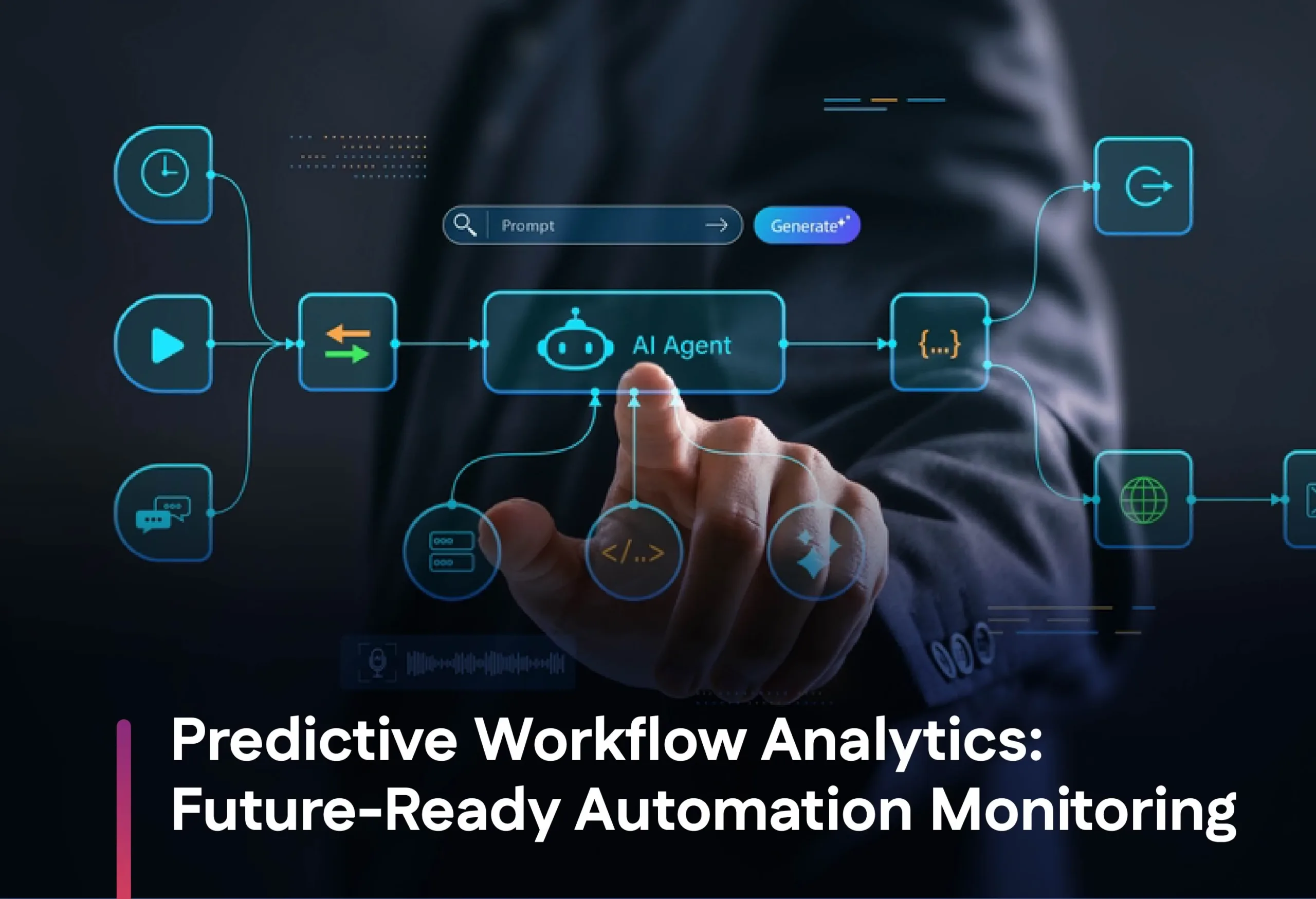
In today’s rapidly evolving digital transformation era, AI workflow monitoring has become the foundation of every successful automation strategy. As organizations scale their automated processes across departments and systems, having superhero-level visibility into AI and automation workflows is no longer a luxury; it has become a critical business imperative.
With automation growing more complex, enterprises now require real-time oversight, predictive insights, and instant error detection to keep operations running flawlessly. This is where modern platforms redefine the game.
AutomationEdge is revolutionizing workflow monitoring in 2026 with its next-generation AI driven solutions, delivering unprecedented visibility, predictability, and control across thousands of automated and AI-driven workflows. This cutting-edge platform transforms how businesses monitor, optimize, and manage their automation pipelines, moving them from reactive troubleshooting to proactive, intelligence-driven workflow management.
By combining AI, observability, predictive analytics, and deep automation insights, AutomationEdge empowers enterprises to:
- Detect issues early
- Prevent failures before they occur
- Optimize performance continuously
- Ensure compliance effortlessly
- Maximize automation ROI
In short, the future of automation excellence begins with mastering AI-powered workflow monitoring, and AutomationEdge leads the way.
What Is AI Workflow Monitoring?
AI workflow monitoring is the real-time tracking, analysis, and optimization of automated processes using AI, predictive analytics, and intelligent alerts to ensure automation runs smoothly, securely, and with maximum efficiency.
The Core Foundations of Workflow Monitoring
The foundation of effective AI workflow monitoring lies in its ability to provide real-time operational insights. Modern organizations face increasing complexity in their automation landscapes, making comprehensive monitoring capabilities essential for:

- Proactive bottleneck identification and elimination
- Early error detection and resolution
- Automated compliance monitoring and audit trail maintenance
- Data-driven resource allocation optimization
Advanced Workflow Optimization Capabilities
Workflow optimization with AI has reached new heights through drill-down capabilities that allow organizations to:
- Analyze individual workflow components with microscopic precision
- Track execution times and performance metrics
- Transform adequate processes into exceptional ones through AI-driven insights
- Implement predictive maintenance and optimization
The evolution of automation workflow monitoring has brought unprecedented error management capabilities.
Modern platforms leverage AI to:

- Convert complex technical issues into actionable insights
- Enable real-time issue tracking and resolution
- Provide precise error source identification
- Facilitate proactive problem prevention
The integration aspect of AI workflow monitoring has become increasingly crucial. Today’s solutions seamlessly connect with existing enterprise systems, from ERP to CRM platforms, ensuring comprehensive visibility across the entire technology stack. This ecosystem approach guarantees complete operational oversight, regardless of workflow complexity.
A standout feature of modern AI workflow monitoring is its graphical visualization capabilities. These interactive maps transform complex automated processes into clear, navigable journeys, enabling operators to:
- Switch effortlessly between different operational views
- Focus on critical process details
- Understand the complete operational landscape
- Make data-driven decisions faster
Top 5 Insurance Workflow Automation Examples – Read This Blog
Manual vs Automated Workflow Monitoring: What’s the Difference?
Manual workflow monitoring involves human operators reviewing workflow health, identifying failures, and responding to issues manually. This approach is slower, resource-heavy, and prone to human error.
Automated workflow monitoring, especially with AI, continuously analyzes workflows, sends proactive alerts, predicts failures, and provides real-time visibility across systems—all with minimal human intervention.
| Capability | Manual Monitoring | Automated (AI) Monitoring |
|---|---|---|
| Error Detection | Reactive, after issue occurs | Real-time, predictive alerts |
| Scalability | Limited, cannot handle large workflows | Highly scalable for 100s–1000s workflows |
| Accuracy | Human errors possible | High accuracy, ML-driven insights |
| Compliance Tracking | Manual documentation | Auto-generated logs & audit trails |
| Speed of Resolution | Slow | Instant alerts & automated remediation |
| Cost Efficiency | Higher long-term cost | Lower cost due to automation |
| Resource Needs | Heavy human involvement | Minimal human oversight |
| Visibility | Fragmented | Unified Command Center view |
Real world Impact and Evolution
The impact of effective automation workflow monitoring is best illustrated through real-world applications. Consider a global financial services firm that transformed its operations through advanced monitoring capabilities. The results included:
- Real-time visibility into all automation processes
- Immediate error detection and resolution
- Significant reduction in operational bottlenecks
- Measurable improvements in resource utilization
Looking ahead, AI workflow monitoring continues to evolve with emerging trends such as:
- Predictive analytics for workflow optimization
- Integration of AI and machine learning for enhanced monitoring
- Industry-specific monitoring solutions
- Advanced security and compliance features
Benefits and Business Impact
For organizations seeking to optimize their automation investments, implementing robust AI workflow monitoring is crucial. The benefits include:

- Enhanced operational efficiency
- Strengthened compliance and governance
- Optimized resource allocation
- Proactive issue resolution
As automation becomes increasingly central to business operations, the role of AI workflow monitoring becomes more critical. Modern platforms offer comprehensive, user-friendly solutions that serve as the ultimate command center for automation operations.
For organizations looking to maximize their automation investments, workflow optimization with AI has become a non-negotiable capability. Modern platforms provide deep real-time visibility, predictive intelligence, and automated decision-making that help enterprises run automation at scale, reliably and efficiently.
Here are the most impactful benefits for enterprises:
-
Enhanced Operational Efficiency
AI-driven insights eliminate inefficiencies, reduce manual oversight, improve workflow performance, and ensure automation uptime.
Result: Faster processes, increased throughput, and reduced operational friction. -
Proactive Issue Resolution (Instead of Reactive Fixing)
AI detects bottlenecks, anomalies, and performance drops before they impact operations.
Result: Fewer workflow failures, faster resolutions, and near-zero downtime. -
Strengthened Compliance & Governance
Automated audit trails, policy checks, and monitoring logs help maintain regulatory compliance effortlessly.
Result: Reduced compliance risk and simplified audits. -
Optimized Resource Allocation
AI analyzes workload patterns and performance metrics to recommend optimal resource usage.
Result: Lower operational costs and improved system utilization. -
Predictive Performance Optimization (2026 Trend)
Machine learning models forecast delays, capacity issues, and errors.
Result: Teams can fix issues hours in advance instead of after failures. -
End-to-End Workflow Visibility Across the Enterprise
Unified dashboards monitor RPA bots, AI agents, APIs, ERP workflows, and third-party integrations.
Result: Complete centralized control over all automation activities. -
Lower Operational Costs
Fewer failures, reduced manual intervention, and optimized workflows decrease operational expenses.
Result: Higher automation ROI year-over-year. -
Improved Scalability for Enterprise Automation
Monitoring supports 100s to 1000s of concurrent workflows without compromising visibility or performance.
Result: Enterprises scale automation confidently.
How AutomationEdge Solves Workflow Monitoring Challenges
AutomationEdge tackles workflow monitoring challenges by offering real-time visibility, predictive analytics, and intelligent alerting across all AI and automation processes. Its Command Center centralizes monitoring for RPA, AI agents, APIs, legacy systems, and enterprise apps, giving teams a single source of truth.
-
Unified Monitoring Across All Systems
AutomationEdge brings ERP, CRM, core banking, HR, and legacy systems under one monitoring layer to eliminate fragmented oversight.
-
Predictive Error Detection & Auto-Resolution
AI models identify failures before they happen and can trigger auto-remediation actions to avoid workflow downtime.
-
Intelligent Alerts & Actionable Insights
Smart alerts convert technical problems into easy-to-understand insights, helping teams resolve issues faster.
-
Graphical Workflow Journey Mapping
Interactive maps show every step of the workflow, making it easier to spot bottlenecks and dependencies.
-
Seamless Integration With Enterprise Tech Stack
Prebuilt connectors ensure AutomationEdge fits smoothly into existing IT ecosystems, no major restructuring needed.
-
Industry-Ready Monitoring Templates
Purpose-built workflows for banking, healthcare, insurance, and telecom accelerate deployment and reduce monitoring complexity.
Conclusion
Organizations looking to stay competitive must embrace advanced workflow monitoring capabilities. With AI-driven insights, real-time visibility, and proactive problem-solving, businesses can transform their automation initiatives from good to exceptional, ensuring sustained operational excellence in an increasingly automated world.
The future of workflow optimization with AI is here, and it starts with gaining complete command of your automation landscape through sophisticated monitoring capabilities. Those who embrace these advanced monitoring solutions will be best positioned to lead in the age of intelligent automation.